
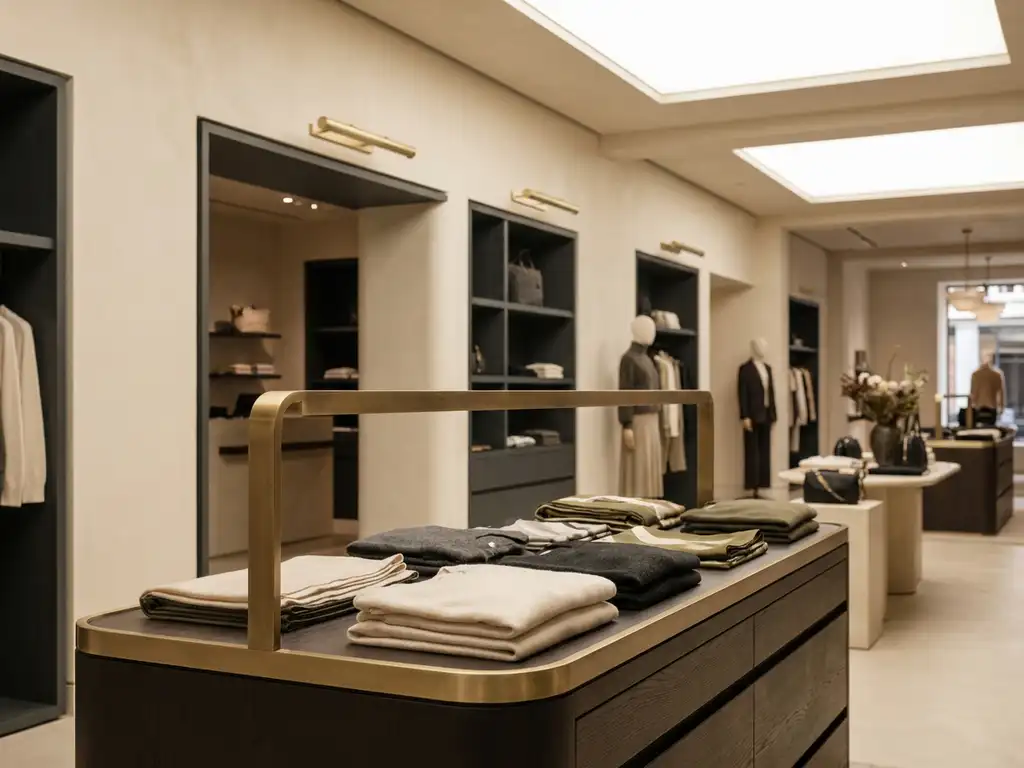
Visual merchandising and store design are distinct but complementary disciplines within retail. Store design defines the physical structure, spatial layout, and architectural framework of a retail environment, while visual merchandising focuses on how products and brand messaging are presented within that space to drive shopper engagement and conversion. Together, they shape the complete in-store experience.
For brands and retailers operating in competitive physical environments, understanding where one discipline ends and the other begins is essential for briefing the right partners, allocating budget effectively, and delivering a coherent customer journey from the moment a shopper enters a store.
Visual merchandising and store design work together by creating a unified in-store experience where the physical environment supports and amplifies product presentation. Store design establishes the canvas — the space, flow, and structure — while visual merchandising brings that canvas to life through product placement, display, signage, and brand storytelling. Neither discipline operates effectively in isolation.
When store design and visual merchandising are developed in alignment, the result is a retail environment that guides shoppers intuitively through the space, builds brand recognition at every touchpoint, and creates the conditions for purchase decisions to be made confidently. Misalignment between the two — for example, a beautifully designed fixture placed in a poorly lit or awkwardly trafficked zone — undermines the investment in both.
Brands that treat these disciplines as a single integrated brief, rather than sequential tasks, consistently achieve stronger in-store performance. The most effective retail environments are those where the structural decisions made during store design actively anticipate the visual merchandising requirements that will follow.
Visual merchandising includes all the decisions and executions that determine how products are displayed, promoted, and experienced within a retail space. This covers product placement and ranging, fixture and display unit selection, point of sale (POS) materials, signage, lighting direction, colour application, and the use of props or brand assets to create a compelling shopper environment.
In practice, visual merchandising operates at two levels. At the macro level, it governs category layout — how product ranges are grouped, sequenced, and signposted across a department or aisle. At the micro level, it addresses individual display execution: how a promotional stand is dressed, how shelf-ready packaging is presented, or how a temporary retail display communicates a product benefit at the point of purchase.
Visual merchandising also encompasses compliance — ensuring that brand guidelines, planograms, and retailer requirements are consistently applied across multiple store locations. For brands distributing through third-party retailers such as pharmacies, department stores, or supermarkets, this compliance dimension is particularly critical to maintaining brand integrity at scale.
Store design covers the structural, spatial, and architectural elements of a retail environment that exist independently of product presentation. This includes floor layout and traffic flow planning, fixture architecture and joinery, lighting infrastructure, material specification, shopfitting, and the overall spatial identity of the retail space. These are decisions made before a single product is placed on a shelf.
Where visual merchandising operates within an existing space, store design defines the space itself. A store designer determines the height and configuration of gondola runs, the placement of feature walls, the positioning of service counters, and the material palette that communicates the brand's physical identity. These structural decisions have a direct bearing on how effective any subsequent visual merchandising programme can be.
Store design also involves longer lead times, higher capital investment, and greater coordination across disciplines including CAD, materials procurement, manufacturing, and installation. It is typically a less frequent activity than visual merchandising — driven by new store openings, significant refits, or brand repositioning rather than seasonal or promotional cycles.
Store design comes first. The physical structure and spatial layout of a retail environment must be established before visual merchandising decisions can be made effectively. Visual merchandising works within the parameters set by store design — the fixture dimensions, traffic routes, lighting conditions, and spatial zones that store design creates all directly shape what visual merchandising can achieve.
However, the most effective retail projects do not treat these as entirely sequential phases. Visual merchandising requirements should inform store design decisions from the outset. If a brand knows it will require a prominent promotional display zone, or that its product range demands a specific fixture depth or lighting temperature, those requirements need to be embedded into the store design brief rather than retrofitted later.
In practice, this means that the briefs for store design and visual merchandising should be developed in parallel, even if execution follows a sequence. Brands that engage a partner capable of managing both disciplines within a single project framework are better positioned to ensure the two phases remain aligned throughout.
A brand should invest in store design when entering a new retail environment, opening a new location, undertaking a significant refit, or repositioning its retail identity. Visual merchandising investment is appropriate on a more frequent basis — to support product launches, seasonal campaigns, promotional periods, or compliance refreshes across existing retail locations.
The distinction matters because the two investments carry different risk profiles and return timescales. Store design is a capital investment with a longer payback horizon, requiring careful planning and a clear brief. Visual merchandising, particularly through POS and temporary display programmes, can be deployed more rapidly and adjusted in response to trading performance or campaign objectives.
For brands distributing through third-party retailers — where they have limited control over the physical environment — visual merchandising through bespoke display units and POS materials is often the primary lever available. In these contexts, the quality and impact of a brand's in-store display solution carry significant commercial weight, directly influencing shopper attention and purchase decisions at the fixture.
Responsibility for store design typically sits with a retail design agency, shopfitter, or in-house design team, while visual merchandising is often managed by brand marketing teams, field sales operations, or specialist retail display partners. In larger organisations, dedicated visual merchandising managers or retail experience directors oversee the discipline. In practice, the most effective projects involve close collaboration between both sets of stakeholders.
For brands working through third-party retailers, responsibility is often split: the retailer controls the structural environment, while the brand is responsible for its own display and POS execution within the space allocated. This makes the quality of a brand's display partner particularly important, as they must deliver solutions that work within retailer constraints while still achieving standout.
When a single partner manages both disciplines within a unified project framework, the risk of misalignment between store design and visual merchandising is significantly reduced. End-to-end capability — spanning concept, design, manufacturing, and installation — ensures that structural and presentational decisions are made with full awareness of each other, producing a more coherent and commercially effective retail environment.
Pivotal is a UK-based, full-service retail design company that manages the complete project lifecycle from initial concept through to on-site installation. For brands seeking to strengthen their in-store presence, Pivotal provides an integrated capability that spans both visual merchandising and retail display design, ensuring structural and presentational decisions are developed in alignment rather than in isolation.
Brands that require a trusted partner to deliver both creative vision and operational precision at the point of purchase will find Pivotal's end-to-end model a commercially compelling proposition. To discuss your next retail project, get in touch with the Pivotal team today.