
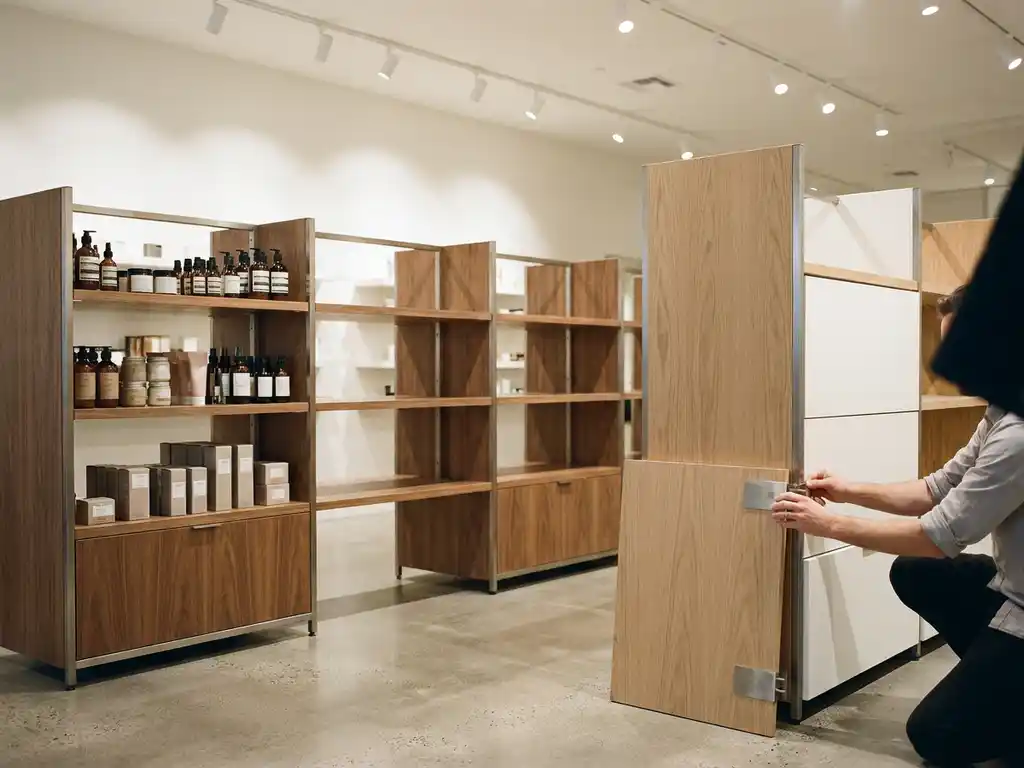
Modular display design is an approach to retail fixtures where individual, standardised components are engineered to connect, reconfigure, and scale across different retail environments. Unlike fixed installations built for a single location, modular retail displays are designed from the outset to be adapted, redeployed, and updated without requiring a completely new build. Brands operating across multiple retail channels, or those managing frequent product launches and seasonal campaigns, benefit most from this approach. The sections below address the key questions brand owners and retail managers ask when evaluating modular display systems.
Modular display design uses a system of interchangeable, pre-engineered components that can be assembled in multiple configurations, whereas bespoke retail fixtures are custom-built to a single, fixed specification for a defined space. The core distinction is flexibility: modular systems are designed to evolve, while bespoke fixtures are optimised for permanence and a specific brief.
Bespoke fixtures deliver the highest degree of creative precision. When a brand requires a completely unique structural form, a specific material combination, or a display that becomes a centrepiece within a flagship store, a custom-built solution is the appropriate choice. The trade-off is that bespoke fixtures are typically tied to a single location and a single campaign cycle.
Modular display units, by contrast, are engineered with a component logic. Shelving panels, header frames, graphic carriers, and base units are designed to connect consistently, meaning the same physical assets can be reconfigured for a pharmacy fixture, a department store gondola, or a pop-up retail space. This makes modular systems particularly well suited to brands managing multi-retailer distribution, where space allocations and planogram requirements differ between accounts.
A modular display system typically consists of a structural frame or upright, interchangeable shelf or tray units, graphic panels or header boards, and a base or footer section. These components are engineered to connect through a consistent fixing system, allowing the display to be assembled, reconfigured, or extended without specialist tools or structural alteration.
The specific components vary by application, but most modular retail display systems share the following core elements:
Materials across these components typically include steel, aluminium, acrylic, and engineered wood, chosen based on the weight requirements, retail environment, and the brand's aesthetic brief. The quality of the connector system is particularly critical: a modular display is only as reliable as the mechanism that holds its components together under daily retail conditions.
A brand should choose modular displays over permanent installations when the retail brief requires flexibility across multiple locations, when campaign cycles demand regular graphic or layout updates, or when the business case for a fixed installation cannot be justified against the projected trading period. Modular retail displays offer a stronger return when the same physical asset needs to work across more than one environment.
Several specific scenarios favour a modular approach:
Permanent installations remain the right choice where a brand has a long-term, fixed retail presence and the brief calls for a high-impact, architecturally integrated fixture. The decision ultimately rests on the ratio of flexibility to longevity required by the retail strategy.
Modular displays support sustainable retail design by extending the operational lifespan of physical assets, reducing material waste associated with single-use campaign fixtures, and enabling component-level repair or replacement rather than whole-unit disposal. Because individual parts can be swapped out independently, modular retail display systems generate significantly less waste over a brand's display lifecycle.
The sustainability case for modular systems operates at several levels. First, the structural components are designed for repeated use across multiple campaigns and retail environments, which reduces the frequency of full fixture replacement. Second, when a component reaches the end of its useful life, it can be replaced in isolation rather than requiring the entire display to be decommissioned. Third, the ability to update graphic panels independently means that branded communication can evolve without generating the material waste associated with replacing structural elements.
Material selection also plays a role. Modular systems designed with sustainably sourced timber, recycled metals, or recyclable acrylic deliver a lower environmental footprint than single-use display builds. For brand owners operating under corporate sustainability commitments, a modular approach to in-store display design provides a credible, measurable contribution to reducing the environmental impact of retail marketing activity.
Modular display systems are used most effectively in health and beauty, food and beverage, fashion accessories, and consumer electronics retail, where product ranges are broad, planograms change frequently, and brands distribute across multiple retail accounts simultaneously. These sectors share a common need: a display infrastructure that can accommodate product range updates without requiring a full fixture rebuild.
In health and beauty, brands operating across pharmacy chains, department stores, and specialist retailers benefit from modular systems that can be configured to meet each retailer's space allocation while maintaining consistent brand identity. The ability to update graphic panels in line with seasonal campaigns or new product introductions is particularly valuable in this sector.
Food and beverage brands managing promotional activity across grocery multiples and convenience formats use modular point of sale display units to maintain a consistent brand presence while adapting to the significant variation in available floor space between store formats. Fashion and accessories brands operating concessions within department stores similarly benefit from the ability to reconfigure fixture layouts as product ranges evolve across seasons.
To brief a retail design partner on a modular display project effectively, provide a clear account of the retail environments the display must operate in, the product range it needs to accommodate, the campaign lifecycle it must support, and any retailer-specific compliance requirements. The more precisely the brief defines the operational parameters, the more accurately the design team can engineer a modular system that performs across all required contexts.
A strong brief for a modular retail display project typically covers the following:
Engaging a retail design partner early in the briefing process allows the structural and graphic design work to develop in parallel, which reduces project timelines and ensures that the modular system is engineered to meet the full operational brief rather than adapted after the fact. Connecting with the design team before finalising the brief is often the most efficient starting point.
Pivotal is a full-service retail design partner that manages modular display projects from initial concept through to manufactured product and on-site installation. Working with brand owners across health, beauty, food and beverage, and lifestyle sectors, Pivotal brings together in-house design, CAD, prototyping, and manufacturing capabilities under a single project management structure. Key aspects of the service include:
For brands seeking a retail display partner capable of managing the full project lifecycle, get in touch with Pivotal to discuss your modular display brief.