
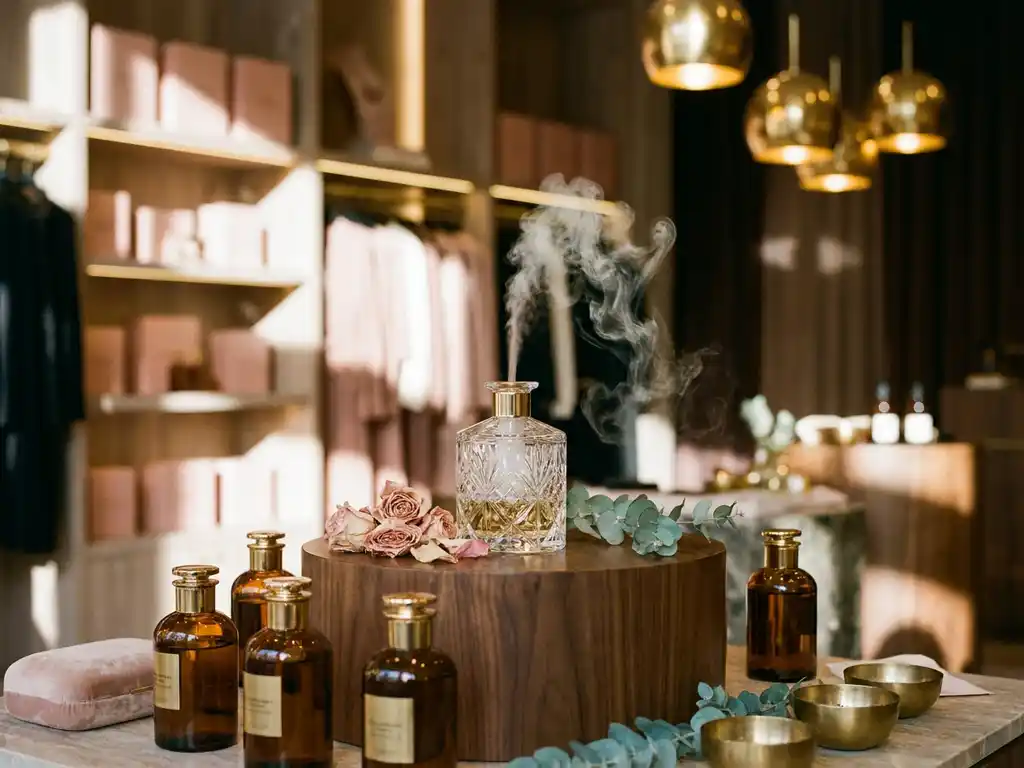
Scent plays a measurable role in the retail brand experience by influencing how shoppers perceive a space, how long they dwell, and how strongly they connect with a brand on an emotional level. Unlike visual or auditory stimuli, olfactory signals bypass rational processing and trigger memory and emotion almost instantly, making scent one of the most direct routes to affective response in a physical environment. The questions below unpack how scent works in practice, where it is most effective, and what brands need to consider before integrating it into their in-store strategy.
Scent influences shopper behaviour by triggering emotional and memory-based responses that affect mood, dwell time, and purchase intent. Because the olfactory system connects directly to the brain's limbic region, which governs emotion and memory, a carefully chosen ambient scent can make a retail environment feel more welcoming, more premium, or more aligned with a specific brand identity, all before a shopper consciously engages with any product.
Industry experience consistently shows that shoppers spend more time in pleasantly scented environments and rate those environments more favourably than unscented equivalents. This extended dwell time directly correlates with increased product interaction and, in many cases, higher basket value. The effect is not accidental. It is the result of deliberate sensory design decisions made at the retail planning stage. When scent is chosen to complement the visual and spatial identity of a store, it reinforces the overall atmosphere rather than creating a dissonant sensory experience that shoppers notice but cannot place.
Ambient scent is a fragrance diffused throughout a retail environment to shape the overall atmosphere, while product scent is the natural or added fragrance of a specific item encountered at close range. The distinction matters because each operates at a different stage of the shopper journey and serves a different strategic purpose within sensory marketing.
Ambient scent works at the environmental level. It is typically diffused through HVAC systems or standalone diffusers positioned to ensure even distribution across a floor space. Its purpose is to create a consistent mood, signal brand character, and prime shoppers before they reach any specific product. A fashion retailer might use a signature ambient scent to communicate aspiration; a pharmacy might use clean, clinical notes to reinforce trust and efficacy.
Product scent, by contrast, operates at the point of contact. It is the fragrance released when a shopper opens a jar, handles a fabric, or tests a cosmetic. While brands have less direct control over how product scent is experienced in-store, the display environment surrounding that product can either amplify or undermine the olfactory moment. A well-designed display that allows easy product access supports a richer product scent experience, reinforcing purchase intent at the most critical stage of the decision process.
The retail sectors that use scent marketing most effectively are beauty and personal care, fashion and apparel, food and beverage, and wellness and pharmacy. These sectors share a common characteristic: their products are inherently linked to sensory experience, making olfactory branding a natural extension of their core proposition rather than an add-on.
In beauty and personal care, scent is inseparable from product identity. Brands in this sector, particularly those positioned in premium pharmacy and department store environments, use both ambient and product scent to build a coherent sensory narrative across the entire fixture. In fashion, signature scents have become a recognised tool for reinforcing brand aspiration and creating a sense of place that shoppers associate with the brand long after leaving the store.
Food and beverage retail uses scent differently, often relying on the natural aromas of the product itself, strategically ventilated or positioned to draw shoppers toward specific zones. In wellness and pharmacy settings, scent choices tend toward clean, reassuring, and clinical profiles that reinforce category credibility. Each of these applications reflects the same underlying principle: scent should serve the brand's existing identity, not contradict it.
Scent works most effectively in retail when it is integrated as part of a cohesive sensory design strategy that aligns with lighting, materials, spatial layout, and visual merchandising. When olfactory, visual, and tactile elements reinforce the same brand message, the cumulative effect on shopper perception is significantly stronger than any single element could achieve in isolation.
Consider how lighting temperature affects the way a scent is perceived. Warm amber lighting paired with woody or amber-based fragrances creates a coherent sensory environment that communicates warmth and luxury. Cool white lighting paired with fresh, clean scents reinforces clinical precision or natural purity. These combinations are not accidental. They are the result of deliberate decisions made during the retail design process.
Material choices also interact with scent. Natural materials such as wood and stone have their own subtle olfactory signatures that can complement or conflict with a diffused fragrance. A display constructed from raw timber, for example, introduces a natural, organic note into the sensory environment that a synthetic fragrance may need to account for. This is one reason why an in-store scent strategy is most effective when it is considered during the design and development phase of a retail display, rather than applied retrospectively.
Yes, scent can reinforce brand identity at the point of purchase when it is consistent with the brand's visual identity, values, and target audience. A signature scent used consistently across retail touchpoints becomes a recognisable brand asset, creating olfactory brand recall that extends beyond the store and into the shopper's memory.
At the point of purchase specifically, scent serves a confirmation function. By the time a shopper reaches a product display, they have already been primed by the ambient environment. A scent that aligns with the product's positioning, whether that is clinical efficacy, natural provenance, or premium luxury, reinforces the decision the shopper is about to make. It reduces cognitive dissonance and strengthens the emotional case for purchase.
For brands investing in bespoke retail display design, this means that scent strategy and physical display design should be developed in parallel. A display that communicates premium quality through its materials, form, and finish should be supported by a sensory environment that makes the same statement. Misalignment between the two creates a gap that shoppers may not consciously identify but will feel as a lack of coherence in the overall brand experience.
The practical challenges of using scent in retail include controlling diffusion consistency, avoiding olfactory fatigue, navigating retailer restrictions, and ensuring that chosen fragrances do not conflict with adjacent products or brand environments. These are operational considerations that require planning, retailer collaboration, and ongoing management.
Diffusion consistency is one of the most common issues. A scent that is too strong near the diffusion point and too faint at the perimeter of the display creates an uneven experience. Achieving even distribution requires careful positioning of diffusion hardware and an understanding of airflow patterns within the specific retail environment.
Olfactory fatigue, the phenomenon in which prolonged exposure causes shoppers and staff to stop perceiving a scent, is a real limitation. It means that the impact of in-store scent is most pronounced in the first moments of exposure, making entrance areas and high-traffic zones particularly valuable for olfactory branding.
Retailer restrictions present a further constraint. Many major retailers, particularly those operating shared floor environments such as department stores or pharmacies, have policies that limit or prohibit the use of diffused fragrances by individual brands. In these contexts, scent strategy must focus on product-level olfactory experience rather than ambient diffusion, placing even greater importance on the display design itself to carry the sensory and brand narrative.
Pivotal designs and develops bespoke in-store display solutions that account for the full sensory context of the retail environment, not just the visual. For brands looking to integrate scent as part of a coherent in-store brand experience, the physical display is the foundation on which every other sensory element rests.
For brands ready to develop retail displays that support a stronger, more coherent in-store brand experience, connect with Pivotal to begin the conversation.