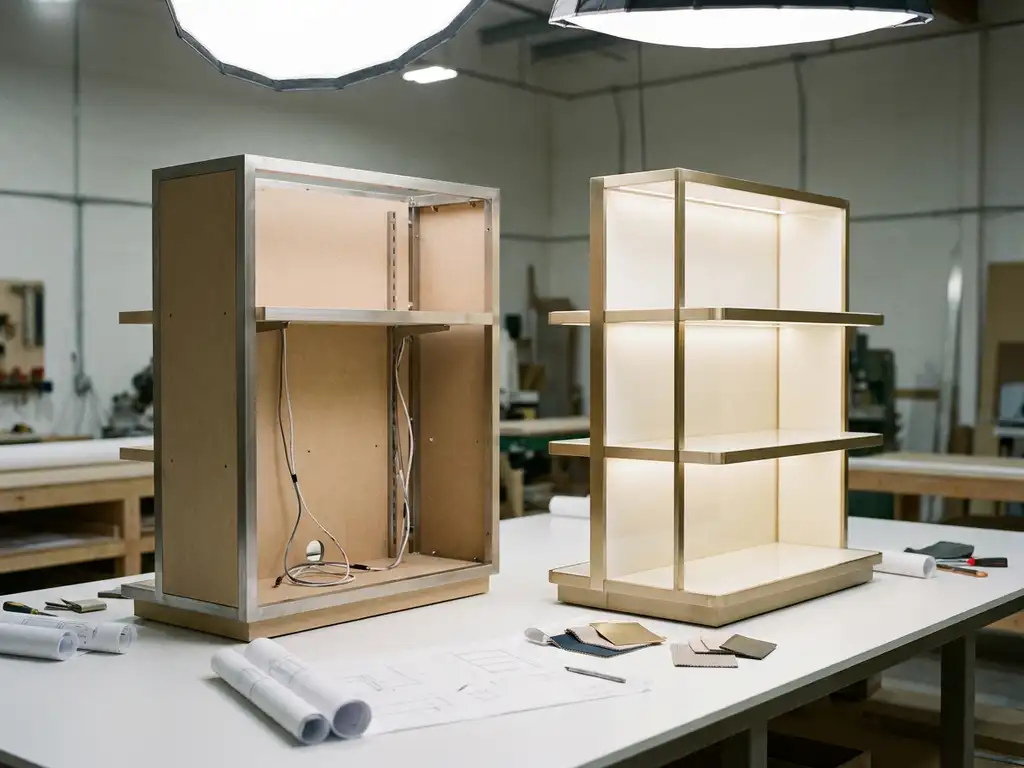
Half-finished luxury retail display unit beside its completed twin, showing raw MDF and metalwork contrasting with glossy champagne gold acrylic panels.
Should you prototype a retail display unit before full production?
Skipping retail display prototyping risks structural failures and wasted budgets — here's what brands need to know first.

Yes, brands should prototype a retail display unit before full production. Prototyping allows design teams, brand managers, and retail partners to physically evaluate a display before committing to manufacturing at scale, reducing the risk of costly errors, structural failures, and poor in-store performance. The sections below address the most important questions surrounding retail display prototyping and what it means for production decisions.

What are the risks of skipping the prototype stage?

Skipping the prototype stage in retail display production exposes a brand to significant financial, operational, and reputational risk. Without a physical sample to evaluate, structural weaknesses, material incompatibilities, and assembly errors go undetected until full production is already underway, at which point corrections become expensive and time-consuming.

The most common consequences of bypassing prototyping include:

  • Structural failure in-store: A display that has not been load-tested may collapse or warp under the weight of the product, creating a safety hazard and damaging brand credibility at the point of purchase.
  • Graphic misalignment: Printed panels, digital screens, or branded elements that look correct in a CAD render may not translate accurately to physical materials, resulting in costly reprints.
  • Retailer non-compliance: Major retail chains operate strict fixture specifications. A display built without a prototype review may fail compliance checks, delaying installation or being rejected entirely.
  • Wasted production budget: Manufacturing hundreds of units from an unvalidated design means any flaw is multiplied across the entire run, dramatically increasing waste and remediation costs.

In short, the cost of a prototype is almost always lower than the cost of correcting a full production run. For brands operating across multiple retail environments, the stakes are even higher.

How does prototyping improve a retail display's in-store performance?

Prototyping improves in-store performance by enabling teams to test how a display functions in real-world conditions before it reaches the shop floor. A physical prototype reveals how shoppers interact with the unit, how well it communicates the brand, and whether the design drives engagement at the point of purchase.

Performance improvements achieved through prototyping typically fall into three areas:

Shopper interaction and accessibility

A prototype allows merchandising and insight teams to assess how easily a shopper can browse, reach, and engage with products. Shelf heights, product angles, and signage placement can all be adjusted based on physical testing rather than assumption. This is particularly valuable in pharmacy and health retail environments, where product accessibility directly influences purchase decisions.

Brand communication at fixture level

Graphics, colour, material finish, and lighting all read differently in physical form than they do on screen. Prototyping provides the opportunity to validate that the display communicates the intended brand message clearly and consistently under the lighting conditions of the target retail environment. Adjustments made at this stage cost a fraction of what they would in full production.

Brands that invest in thorough retail display development before committing to scale consistently achieve stronger in-store results, with fewer post-installation corrections and greater retailer satisfaction.

What types of retail displays benefit most from prototyping?

Complex, high-visibility, and structurally demanding retail display units benefit most from prototyping. While any display can benefit from a physical review, certain categories carry a higher risk profile if produced without validation, making prototyping particularly important.

  • Permanent fixtures and shop-in-shop installations: These are long-term investments built to retailer specification. Any structural or compliance issue discovered after installation is both costly and disruptive to the retail partner.
  • Multi-component POS display systems: Displays with interlocking parts, adjustable shelving, or modular configurations require physical assembly testing to confirm that all components fit and function as intended.
  • Premium and luxury brand displays: In sectors such as beauty, skincare, and fragrance, the tactile quality of a display is integral to the brand experience. Prototyping validates material choices, finishes, and construction quality before the brand commits to production.
  • Temporary promotional displays with tight deployment timelines: Although counterintuitive, temporary displays used in high-footfall environments during promotional periods benefit from prototyping because errors discovered post-production leave no time for correction.
  • Exhibition and event stands: Displays designed for venues such as the NEC must be built, dismantled, and rebuilt repeatedly. Prototyping confirms structural integrity and ease of assembly under real conditions.

How long does it take to prototype a retail display unit?

The time required to prototype a retail display unit typically ranges from one to four weeks, depending on the complexity of the design, the materials involved, and the number of review cycles required. Simple POS display prototypes built from standard materials can be produced more quickly, while complex fixtures involving joinery, metalwork, or bespoke moulding require more time.

Key factors that influence prototype lead time include:

  • Design readiness: If CAD drawings and material specifications are finalised before prototyping begins, the process moves significantly faster.
  • Material availability: Bespoke materials such as custom acrylic formulations or specialist laminates may require procurement lead time before physical production can begin.
  • Review and approval cycles: Each round of stakeholder feedback that results in design changes adds time. Brands that consolidate feedback internally before reviewing the prototype reduce overall timelines.
  • Number of variants: If a brand requires prototypes of multiple colourways, sizes, or configurations, the timeline extends accordingly.

Rapid prototyping capabilities, where available, can compress timelines considerably by using CNC machining or 3D printing to produce review samples before final materials are committed.

What is the difference between a prototype and a pre-production sample?

A prototype is an early-stage physical model used to test and refine a design, while a pre-production sample is a final representation of the approved design built using production-ready materials and processes. Both are distinct stages in the retail display manufacturing process and serve different purposes.

The key distinctions are as follows:

  • Purpose: A prototype is exploratory and iterative. It is used to identify problems and test design decisions. A pre-production sample is confirmatory. It validates that the approved design can be manufactured consistently at scale.
  • Materials: Prototypes may use substitute materials to approximate the final finish and structure. Pre-production samples are built from the exact materials and components specified for the production run.
  • Finish quality: Prototypes are often rougher in finish and may show construction details that would be concealed in the final product. Pre-production samples must meet the same finish standard as the production units.
  • Approval stage: Prototype approval confirms the design direction. Pre-production sample approval triggers the full manufacturing run. Confusing the two stages can lead to premature production sign-off.

Brands working with an experienced retail display manufacturer will typically move through both stages before production begins, with each serving a clearly defined role in the project lifecycle.

When should a brand approve a prototype before full production?

A brand should approve a prototype only when the display meets all structural, aesthetic, compliance, and brand standards in physical form. Approval should never be granted based on digital renders alone, nor should it be rushed to meet a production deadline if outstanding issues remain unresolved.

The prototype approval process should confirm the following before sign-off:

  • The display is structurally sound and can bear the intended product load without deformation.
  • All branded graphics, colours, and finishes match approved brand guidelines under relevant retail lighting conditions.
  • The display meets the dimensional and compliance requirements of the target retail environment.
  • Assembly and installation can be completed by fitters within the expected time and without specialist tools.
  • Any feedback from internal stakeholders, retail partners, or compliance teams has been reviewed and addressed.

Where a brand has multiple retail partners with different fixture specifications, separate approval may be required for each variant. Rushing prototype approval is one of the most common causes of costly post-production corrections, and the decision should be treated as a commercial checkpoint rather than a formality.

How Pivotal helps brands prototype retail display units with confidence

Pivotal offers a fully integrated approach to retail display prototyping, supporting brands from initial concept through to pre-production sign-off. As a full-service retail design partner, Pivotal manages the entire process in-house, reducing handoff risk and ensuring that design intent is preserved through every stage of production.

  • In-house rapid prototyping using CNC machining, 3D printing, and skilled craft production.
  • CAD-led design development that bridges the gap between concept and physical prototype.
  • Material expertise across acrylic, joinery, metalwork, and moulding to ensure prototypes reflect final production quality.
  • Compliance review against retailer specifications before prototype approval.
  • End-to-end project management from prototype through to installation by Pivotal's own employed fitters.

For brands looking to move from design concept to a validated retail display unit without the risk of costly production errors, speak to the Pivotal team to discuss your next project.

Related Articles


Through courage we choose innovation to keep our customers and their shoppers ready for tomorrows retail.
Explore our latest product innovations below ▾