
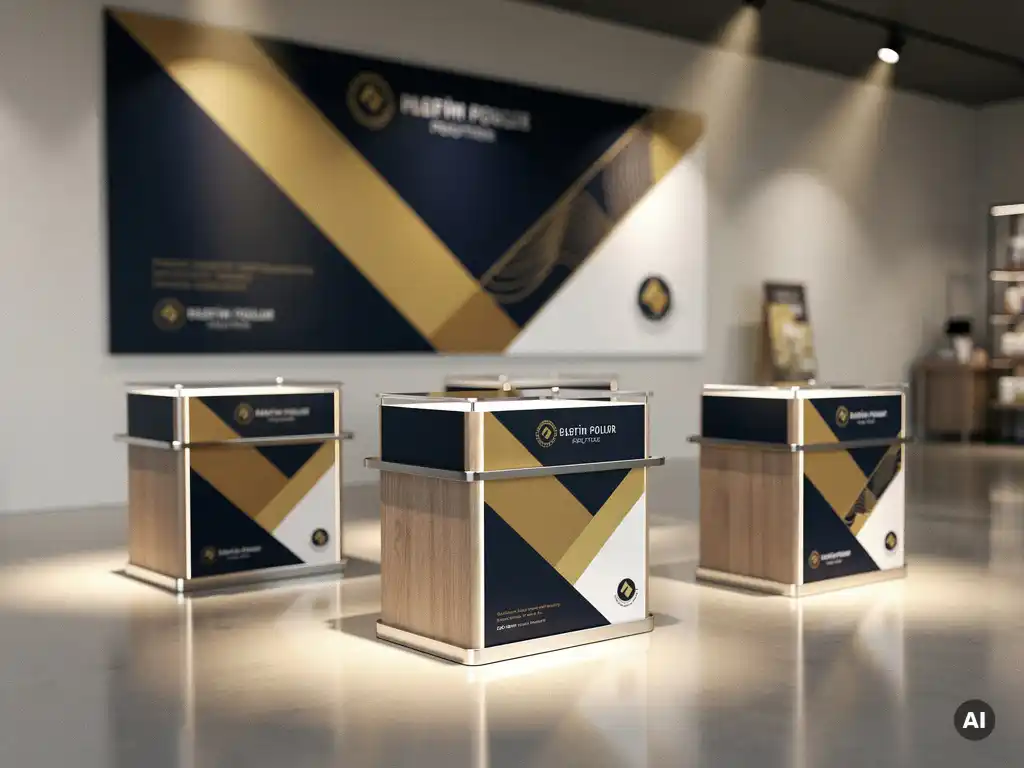
Aligning POS materials with a broader brand campaign requires deliberate coordination between campaign creative and retail design from the outset, not as an afterthought. When POS materials share the same visual language, messaging hierarchy, and emotional tone as the wider campaign, they reinforce brand recognition at the most critical moment: the point of purchase. The sections below address the most common questions brand owners and marketing directors face when managing this alignment in practice.
POS materials feel disconnected from the wider campaign because they are typically developed by a separate team, briefed at a later stage, and constrained by retail formats that were never considered during the original campaign concept. The result is a visual and messaging gap between what shoppers see in advertising and what they encounter in-store.
This disconnect has a structural cause. Campaign creative is usually developed by a brand or advertising agency working to broad media formats, digital, print, out-of-home. Retail design, by contrast, must operate within precise physical constraints: fixture dimensions, retailer guidelines, sight lines, and material specifications. When these two workstreams run in parallel without shared oversight, the retail execution becomes an adaptation rather than an extension of the campaign.
The consequence is measurable. Shoppers who encounter inconsistent brand signals between advertising and in-store display experience a break in the purchase journey. Brand recognition falters at the moment it should be strongest. For brand owners investing significantly in campaign media, this represents a direct reduction in return on that investment.
POS materials should serve as the final, physical expression of a brand campaign, converting the awareness and intent built through above-the-line activity into a purchase decision at the shelf or display. In a well-integrated campaign, point of sale does not simply repeat the campaign message; it amplifies it within the specific context of the retail environment.
This means POS materials carry a dual responsibility. They must be recognisable as part of the campaign, sharing its visual identity, colour palette, and tone, while also functioning as effective retail tools that direct shopper attention, communicate product benefits, and facilitate navigation. A promotional display that looks striking but fails to guide the shopper towards the product has not fulfilled its commercial role.
The most effective POS design treats the retail environment as a campaign channel in its own right, with its own audience behaviour, dwell time, and decision-making context. Campaign messaging that works in a 30-second video or a full-page print ad must be distilled to its essential form for in-store application, where a shopper may engage for only a few seconds.
To brief a retail design team for campaign-aligned POS, share the complete campaign creative pack, including master visuals, typography guidelines, colour specifications, tone of voice documentation, and campaign messaging hierarchy, before any retail design work begins. The retail design team must understand the campaign's intent, not just its aesthetic.
An effective brief for campaign-aligned POS should include the following:
Briefing the retail design team early, ideally during the campaign development phase rather than after campaign creative is finalised, allows for genuine creative integration. It also reduces the risk of costly revisions when retail formats are found to be incompatible with the campaign visuals at a late stage.
Visual consistency between POS materials and campaign creative is achieved through the disciplined application of the same design system: matching colour values, typefaces, imagery style, logo usage, and compositional hierarchy. Consistency is not about replicating the campaign layout; it is about ensuring the retail display is immediately recognisable as part of the same brand expression.
Several specific elements determine whether POS materials read as part of the wider campaign:
Material choice also contributes to visual consistency. A premium campaign positioned around luxury or sustainability should be reflected in the quality and finish of the physical display; a mismatch between campaign positioning and material quality undermines the brand signal at the point of purchase.
Maintaining brand consistency across multiple retail environments requires a combination of modular design systems, precise production standards, and coordinated installation management. When POS materials are deployed across diverse retail formats, from pharmacies to department stores to supermarkets, a single design cannot simply be reproduced at different scales. It must be adapted within a controlled framework.
The most reliable approach is to develop a core design system that defines non-negotiable brand elements alongside flexible parameters that allow adaptation to different fixture types and retailer requirements. This system should be documented clearly so that any adaptation, whether made by an internal team or a manufacturing partner, remains within defined boundaries.
Production consistency is equally important. Colour, finish, and material specifications must be standardised across all manufacturing runs, and quality control processes should verify that each unit meets those standards before installation. Variation in production quality across a national rollout creates visible inconsistency that undermines the campaign's impact.
Installation coordination across multiple locations adds a further layer of complexity. Ensuring that displays are installed correctly, in the right position within the store, and to the retailer's compliance requirements demands experienced installation management, not simply delivery and assembly. Pivotal's employed fitting teams, who are retailer-approved and active across national rollouts, provide the operational consistency that a campaign-aligned deployment requires.
POS materials should be refreshed whenever the campaign enters a new phase, a promotional period changes, or the in-store environment no longer reflects the current brand message. In practice, this means aligning POS refresh cycles with campaign flighting schedules rather than treating retail display as a one-time installation.
There are several trigger points that indicate a POS refresh is necessary:
Planning refresh cycles in advance, as part of the campaign calendar rather than reactively, reduces lead times, controls costs, and ensures that in-store materials are always current. Brands that treat POS as a living element of their campaign strategy consistently achieve stronger visual presence than those who install and leave.
Pivotal provides an end-to-end retail design service specifically structured to close the gap between campaign creative and in-store execution. For brand owners and marketing directors managing complex, multi-environment campaigns, Pivotal operates as a single accountable partner across every stage of the process.
If your brand is preparing a campaign that demands a consistent, high-quality in-store presence, contact Pivotal to discuss how a fully integrated retail design partnership can deliver the results your campaign requires.