
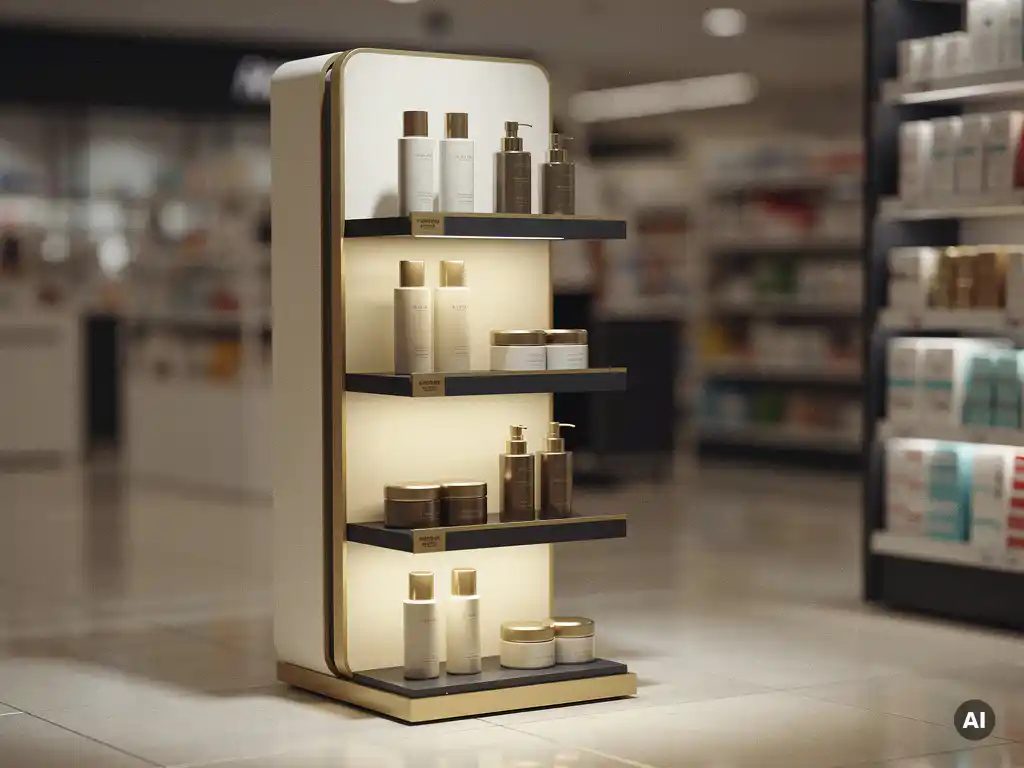
Creating POS displays that work across different store formats requires designing for adaptability from the outset, not retrofitting a single concept after the fact. The most effective approach combines a modular structural framework with consistent brand identity, allowing the same display family to scale, reconfigure, or simplify depending on the retail environment. The sections below address the specific decisions, constraints, and design principles that determine whether a cross-format POS programme succeeds or fails.
Store formats introduce competing constraints that a single fixed display design cannot satisfy simultaneously. Floor space, fixture adjacencies, retailer planogram rules, staff replenishment access, shopper traffic flow, and ceiling height all vary significantly between a pharmacy, a supermarket, and a department store, meaning a display optimised for one environment will often underperform or be rejected outright in another.
The challenge is compounded when a brand sells through multiple retail channels at the same time. A retail POS unit designed for a Boots pharmacy bay operates under entirely different spatial and compliance requirements than a freestanding display in a grocery aisle or a countertop unit in a boutique. Each format has its own physical parameters, its own shopper behaviour patterns, and its own retailer approval process. Designing in isolation for one channel and then attempting to adapt creates cost overruns, delays, and inconsistent brand presentation at the point of purchase.
The consequence of ignoring format diversity at the briefing stage is that brands frequently end up commissioning separate display programmes for each retailer, a far more expensive and time-consuming outcome than designing for multi-format deployment from the start.
The primary store format types that affect in-store display design are: large-format grocery and supermarkets, pharmacy and health retailers, department stores, convenience and forecourt stores, and specialist or independent retailers. Each presents distinct spatial, structural, and compliance requirements that must be factored into the display design brief.
Designing a POS display for multi-format retail means building a modular system rather than a single fixed unit. The display is engineered as a family of components, a core structural chassis, interchangeable header and graphic panels, scalable shelving configurations, and format-specific base options, so that each version shares the same design language while meeting different spatial and retailer requirements.
The process starts at the brief. Before any CAD work begins, the design team must map every intended retail environment: its dimensions, fixture adjacency rules, replenishment requirements, and retailer compliance standards. This information directly shapes the modular architecture of the display system.
Rapid prototyping plays a critical role in validating the concept across formats before committing to full production. Physical prototypes allow brand teams and retail buyers to assess scale, structural integrity, and brand impact in a realistic context, identifying format-specific issues early, when changes are still low-cost. Material selection also matters: choosing materials that are both visually consistent and practically appropriate across different retail environments (acrylic for premium countertop units, powder-coated metalwork for high-traffic grocery environments, joinery for department store installations) ensures the display performs as intended in each setting.
Brand identity elements must remain consistent across every store format version of a POS display. This means the colour palette, typography, logo placement, core graphic messaging, and the overall visual hierarchy should be immediately recognisable regardless of whether the display appears in a pharmacy, a supermarket, or a department store. Consistency at the point of purchase is what builds brand recognition across a fragmented retail estate.
Beyond visual identity, the structural design language should also remain coherent. If the full-size freestanding unit uses a particular material finish or a distinctive structural detail, that same element should appear, scaled or simplified, in the countertop or wall-mounted version. This creates a family of displays that reads as a deliberate, considered programme rather than a collection of disconnected assets.
What can legitimately vary is scale, configuration, material weight, and the quantity of product facings. These are the variables that respond to format-specific constraints without compromising the brand's in-store presence.
Retailer compliance requirements are among the most significant constraints in cross-format POS design, and they differ substantially between retail partners. Each major retailer operates its own fixture approval process, with specific rules governing display footprint, maximum height, weight limits, fixings, fire safety certification, and in some cases the materials permitted on the shop floor. A display that passes approval at one retailer may require structural modification before it can be installed at another.
This is why retailer compliance must be built into the design process, not addressed at the end. Working with a retail design partner whose installation teams are retailer-approved, and who understand the approval requirements of major UK retail environments, significantly reduces the risk of late-stage redesign or rejected rollouts. Compliance knowledge should inform structural decisions, material specifications, and even graphic panel dimensions from the earliest stages of the project.
Brands operating across multiple retail partners should also anticipate that compliance timelines vary. Some retailers require several weeks of review before approving a new display for the shop floor. Factoring these lead times into the project plan is essential for hitting campaign launch dates.
Brief a retail design partner from scratch when you are entering a new retail channel, launching a new product line, or when an existing display was not originally designed with multi-format deployment in mind. Attempting to adapt a display that was built for a single environment is frequently more costly and less effective than designing a modular system correctly from the outset.
Adapting an existing display is a viable option when the original design was built on a modular framework, when the new format requires only a change in scale or configuration, and when the core structural and compliance requirements of the new environment are already satisfied by the existing design. In these cases, adaptation reduces cost and lead time without compromising brand consistency.
The clearest signal that a fresh brief is needed is when an existing display consistently underperforms in certain retail environments, poor sell-through rates, retailer rejection at compliance stage, or negative feedback from in-store teams are all indicators that the display was not designed with that format in mind.
Pivotal is a full-service retail design partner with the in-house capability to design, manufacture, and install POS display systems built for multi-format retail from the ground up. Working with Pivotal means a single partner manages the entire project lifecycle, from initial brief and shopper insight through to CAD, prototyping, manufacturing, and retailer-approved installation across your full retail estate.
If you are planning a cross-format POS programme or need a display system that performs consistently across multiple retail partners, contact Pivotal to discuss your brief.