
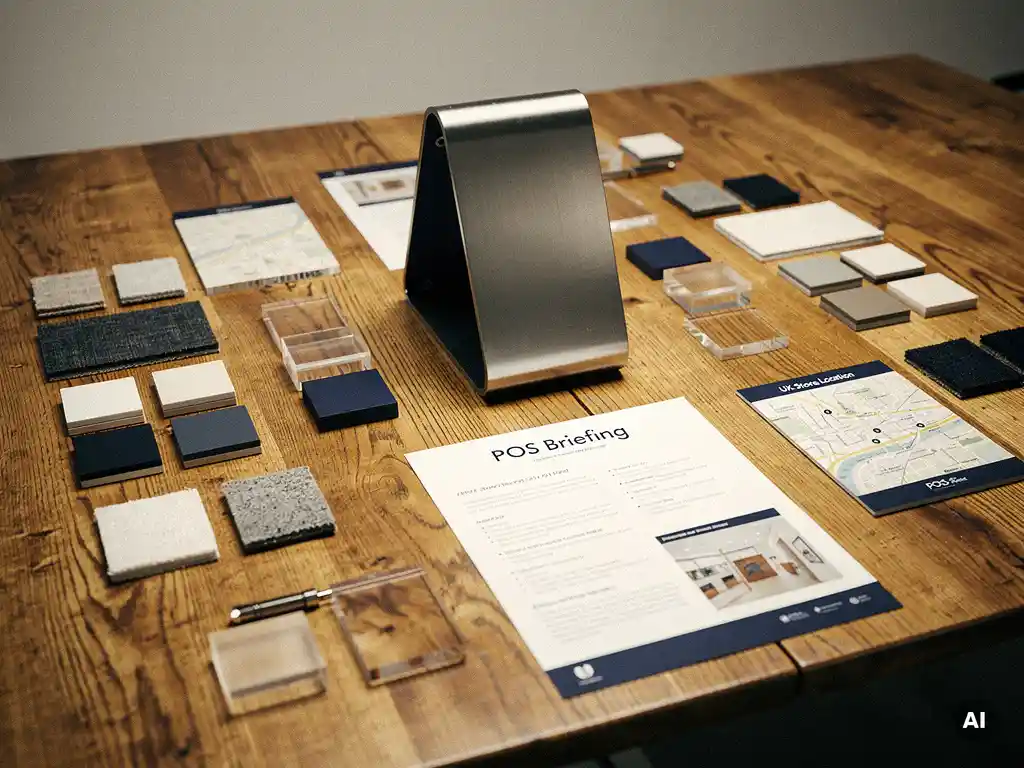
To brief a POS supplier effectively for a nationwide UK campaign, you need to provide a structured document that covers campaign objectives, store location data, retailer specifications, timeline, budget parameters, and brand guidelines before any design work begins. The quality of your brief directly determines the quality of the output, and for a multi-site rollout across hundreds of UK locations, an incomplete brief creates costly delays and inconsistencies. The sections below address the specific questions brand owners and marketing teams most commonly face when preparing a point of sale brief for a large-scale campaign.
A POS supplier needs a clear picture of your campaign objectives, the retail environments where displays will be installed, your brand guidelines, the product or range being promoted, your target shopper profile, the timeline from sign-off to in-store date, and your budget. Without these inputs, any design work produced is speculative rather than strategic.
More specifically, a well-structured point of sale brief should include the following:
The more precise the brief, the more accurate the initial concepts, costings, and production schedules will be. Vague briefs generate vague proposals, and in a nationwide UK campaign, that ambiguity compounds at scale.
For a nationwide UK retail POS campaign, you should brief your supplier a minimum of 12 to 16 weeks before the planned in-store date. This lead time accounts for concept development, retailer approval, prototyping, manufacturing, and logistical coordination across multiple store locations. Campaigns involving bespoke materials, complex structures, or large store counts may require longer.
The timeline typically breaks down as follows:
Brands that brief late frequently face a difficult choice: compromise on quality or miss the launch window. Neither outcome serves the campaign. If your internal timelines are tight, raise this with your supplier at the outset: an experienced retail POS partner can advise on what is achievable and where efficiencies can be found without sacrificing compliance or brand standards.
A creative brief defines the visual and messaging direction for a campaign, the look, feel, tone, and audience. A POS brief translates that creative direction into a physical, commercial, and logistical specification. The two documents serve different purposes and should inform one another, but they are not interchangeable.
A creative brief answers: What should this campaign communicate, and how should it feel to the shopper?
A point of sale brief answers: What physical display is required, where will it be placed, what must it contain, and how will it get there?
In practice, brand teams often share a creative brief with their POS supplier and expect it to serve as the full project brief. This creates gaps. The creative brief rarely includes retailer fixture specifications, store-level quantities, installation logistics, or compliance requirements, all of which are essential for a supplier to scope, cost, and produce a display accurately.
The strongest approach is to use the creative brief as the foundation and build a dedicated POS brief on top of it. Your retail design partner should be able to help you structure this if you are working from a creative brief alone, translating the strategic intent into a production-ready specification.
Briefing for consistency at scale requires a master specification document that defines the non-negotiable elements of the display, structure, materials, dimensions, graphic treatments, and brand standards, alongside a clear process for managing store-by-store variations within that framework. Consistency is not achieved through a single brief alone; it is maintained through disciplined project management and retailer-approved production standards.
Key principles for a consistent nationwide rollout include:
Pivotal's installation teams visited a store every 34 minutes throughout 2025, completing over 2,000 retail and brand experiences across the UK. That operational scale means the infrastructure exists to execute consistency at the level a nationwide retail POS campaign demands.
Before appointing a POS supplier for a nationwide UK campaign, you should ask about their end-to-end capabilities, their experience with your specific retail environments, how they manage retailer compliance, whether they employ their own installation teams, and how they handle project management across multiple concurrent locations. The answers reveal whether a supplier can genuinely deliver at scale or whether they will rely on third parties at critical stages.
Specific questions worth putting to any prospective retail POS partner include:
Appointing the wrong supplier for a nationwide campaign is an expensive lesson. The due diligence invested at the briefing stage directly reduces execution risk across every store in your rollout.
Pivotal is a UK-based, full-service retail design partner that manages the entire POS campaign lifecycle, from initial brief through to on-site installation, using its own employed teams at every stage. For brands planning a nationwide UK rollout, this means a single point of accountability across design, manufacturing, and delivery.
If you are planning a retail POS campaign and want to discuss your brief with an experienced partner, contact the Pivotal team to start the conversation.