
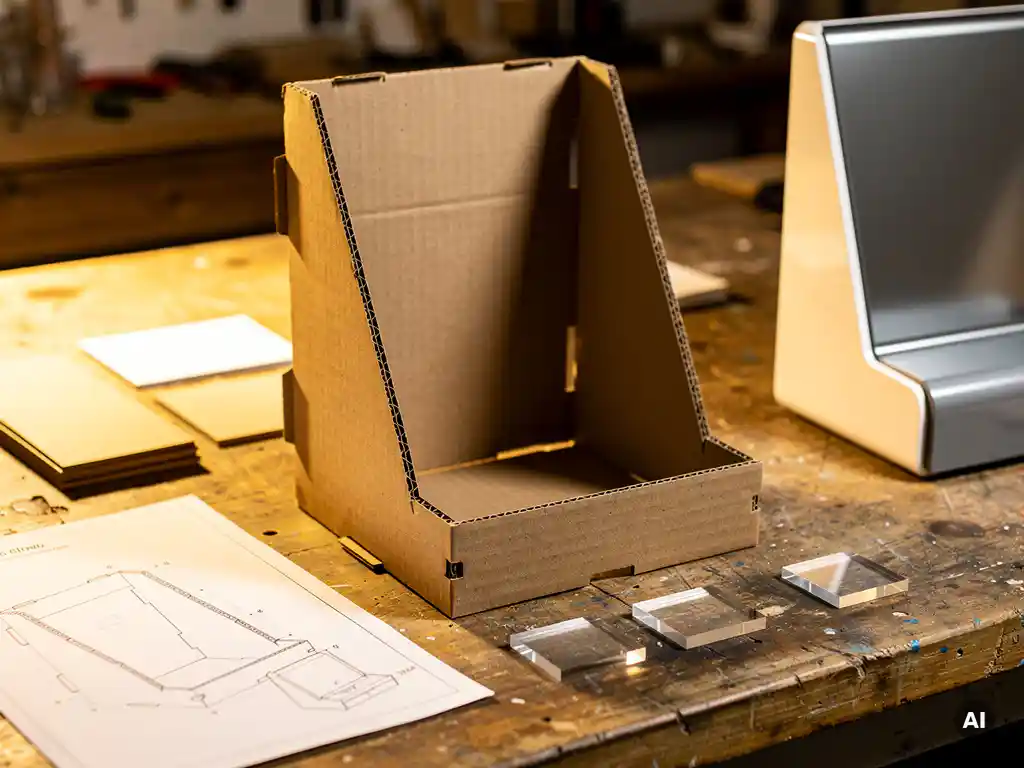
Testing a POS concept before a full UK retail rollout involves a structured sequence of prototyping, in-store piloting, and stakeholder review, designed to validate creative, structural, and commercial performance before committing to large-scale production. The goal is to identify and resolve issues at the lowest possible cost, rather than after thousands of units have been manufactured and distributed. The sections below address each stage of that process in detail.
The primary methods used to test a POS display before rollout are rapid prototyping, controlled in-store pilots, shopper observation, and structured stakeholder review. Each method targets a different layer of risk, from structural integrity and material performance to shopper engagement and retailer compliance. Used in combination, they provide a comprehensive picture of how a display will perform at scale.
Physical prototyping remains the most reliable first step. A working model of the display, built in the intended materials, allows the design and commercial teams to assess dimensions, durability, and brand presentation before any production tooling is committed. This is followed by placement in a live or controlled retail environment, where real shoppers interact with the unit under real conditions. Observational data, sales uplift tracking, and retailer feedback then inform the final sign-off decision.
Digital rendering and CAD visualisation also play a supporting role earlier in the process, allowing design iterations to be reviewed quickly without physical material cost. However, digital validation alone is not sufficient, physical behaviour, material finish, and in-store lighting conditions can only be assessed with a tangible unit.
Rapid prototyping in retail POS is the accelerated production of a physical display model, using materials such as acrylic, wood, metal, or moulded components, that closely replicates the intended final unit. It allows brands and designers to evaluate form, fit, and function before committing to full production runs. The process compresses what was once a lengthy development cycle into a matter of days or weeks.
In practice, rapid prototyping begins with CAD drawings that define precise dimensions, structural requirements, and material specifications. From those drawings, a working prototype is produced, often by hand or using CNC-machined components, and reviewed against the original design brief. Adjustments are made iteratively until the prototype meets both the brand's aesthetic requirements and the retailer's structural and safety standards.
The commercial value of rapid prototyping is significant. Identifying a structural flaw or a dimensional incompatibility at prototype stage costs a fraction of what it would cost to address the same issue after a national rollout. For brands launching into major UK retailers, where shelf space is tightly governed and compliance requirements are strict, this stage is not optional, it is essential.
Running a POS pilot in a live UK retail environment involves selecting a representative sample of store locations, installing the prototype or pre-production display, and measuring performance against defined commercial and operational benchmarks over a set period. The pilot should mirror the conditions of the intended full rollout as closely as possible, same fixture type, same retail format, same consumer demographic.
Store selection is a critical decision. A pilot that runs only in high-performing flagship locations will not produce data that is representative of a national rollout. A well-designed pilot includes a mix of store sizes, footfall levels, and regional demographics to surface any location-specific challenges before they become systemic problems.
During the pilot, data collection should be structured and consistent. This includes sales data from the piloted locations compared to control stores, retailer compliance checks to confirm the display is being maintained correctly, and where possible, direct shopper observation or intercept research. At the end of the pilot period, findings are consolidated into a formal review that either approves the concept for rollout, recommends modifications, or triggers a further round of testing.
A POS concept should be tested against four core criteria before sign-off: retailer compliance, structural durability, shopper engagement, and brand accuracy. Each criterion addresses a distinct failure mode, and a concept that passes on only one or two dimensions is not ready for a full retail rollout.
Sign-off against all four criteria should be documented formally, with input from the brand team, the retail partner, and the production team. Verbal approvals are insufficient at this stage, any ambiguity in the sign-off process creates risk further down the project lifecycle.
The POS testing and approval process should involve the brand's marketing and retail teams, the retail partner's category or space planning team, the design and development partner, and the installation team. Each stakeholder brings a different lens to the review, and excluding any one of them creates blind spots that can derail a rollout.
The brand team is responsible for confirming that the display accurately represents the brand and meets the commercial objectives of the campaign or product launch. The retail partner's team, whether that is a buyer, a space planner, or a compliance manager, must confirm that the display meets their operational requirements and fits within the agreed space allocation. The design and development partner is responsible for confirming that the prototype accurately reflects what will be produced at scale, and that any changes agreed during testing are feasible within the production timeline and budget.
The installation team's involvement is often overlooked at the testing stage, but it is commercially important. Fitters who are familiar with the display before rollout can identify practical installation challenges, fixing methods, component sequencing, weight distribution, that are not visible from a design drawing alone. Involving them early reduces the risk of on-site delays during the national rollout.
Creative testing reduces risk in a full retail rollout by surfacing underperformance at the concept stage, where changes are fast and inexpensive, rather than after production and distribution have been completed. It provides evidence-based confidence that the display will deliver the expected commercial return before significant budget is committed.
The most direct risk that creative testing addresses is shopper irrelevance, the scenario where a display that looks strong in a design presentation fails to engage shoppers in a live environment. Retail environments are visually competitive, and a display that does not cut through at the point of purchase will not drive the uplift the brand is expecting. Testing with real shoppers, in real stores, before full production removes this uncertainty.
Creative testing also protects the brand's relationship with its retail partners. A display that fails structurally, breaches compliance requirements, or underperforms commercially reflects poorly on the brand and can damage the retailer relationship that took significant time and investment to build. Structured testing demonstrates to the retailer that the brand takes its in-store presence seriously and is committed to delivering a quality outcome.
For brands operating across multiple UK retail channels simultaneously, the risk multiplier of skipping creative testing is substantial. A concept that is not validated before rollout can generate compliance failures, installation problems, and commercial underperformance across hundreds of locations at once, a situation that is both costly and difficult to recover from quickly.
Pivotal provides an end-to-end POS testing and validation service, covering every stage from initial concept through to in-store pilot and national rollout. For brands that need confidence before committing to full production, Pivotal's integrated capabilities remove the need to manage multiple suppliers across the testing process.
For brand owners and marketing directors planning a UK retail launch or fixture refresh, early engagement with Pivotal's design and development team ensures that testing is built into the project timeline from the outset, not added as an afterthought. Contact Pivotal to discuss your next POS project and find out how structured concept testing can protect your investment and accelerate your route to market.