
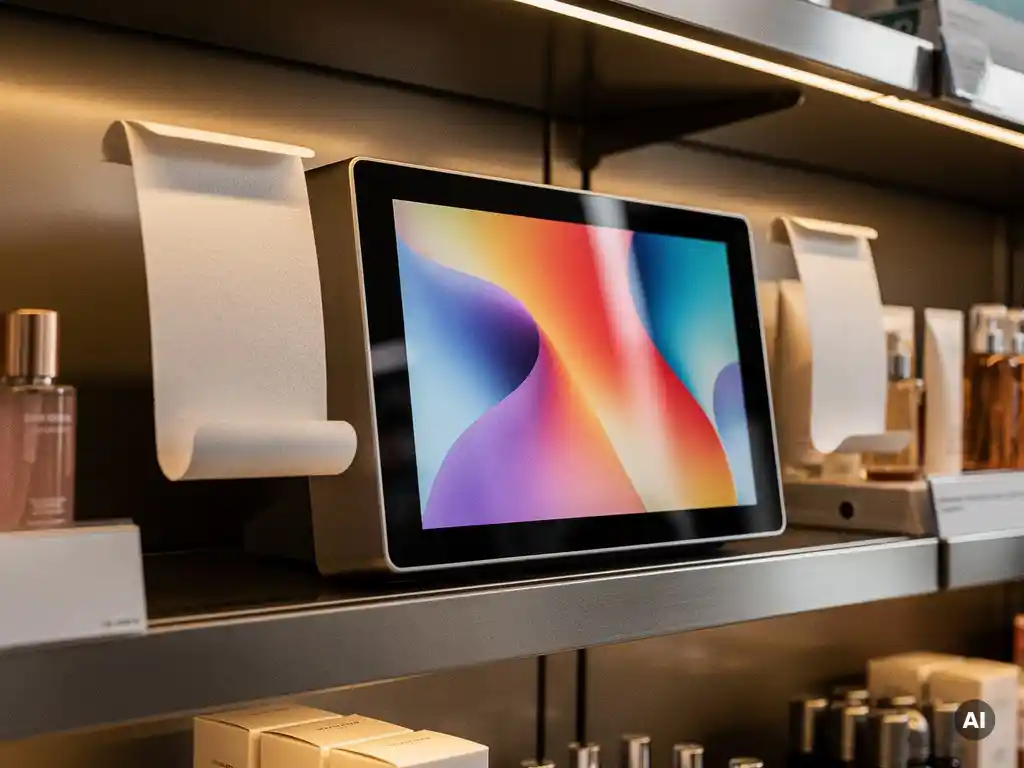
Digital POS displays can outperform printed materials in specific retail contexts, but neither format holds a universal advantage. The deciding factors are environment, product category, shopper dwell time, and budget horizon. For brand owners and retail experience managers, the more productive question is not which format wins outright, but which combination delivers the strongest return at the point of purchase. The sections below address the most common questions brands face when evaluating digital versus printed in-store display strategies.
Digital POS displays outperform printed materials on engagement because they deliver motion, interactivity, and real-time content updates in a way static print cannot. Moving imagery attracts peripheral attention more effectively than a fixed graphic, and the ability to rotate messaging means a single unit can serve multiple promotional objectives simultaneously without requiring a physical reprint or refit.
Beyond motion, digital screens enable contextual relevance. Content can be scheduled by time of day, triggered by stock availability, or tailored to seasonal campaigns without any physical intervention at store level. For brands managing complex promotional calendars across multiple retail locations, this flexibility represents a significant operational advantage.
Interactivity adds a further dimension. Touchscreen units allow shoppers to explore product ranges, access ingredient information, or locate complementary items independently, extending engagement time at the fixture. In beauty and health categories particularly, where purchase decisions are often research-led, this depth of information delivery can meaningfully influence conversion.
Printed POS materials outperform digital screens in environments where cost sensitivity, installation constraints, or shopper behaviour make static displays the more practical and effective choice. Shelf-edge strips, header cards, floor stands, and counter units remain highly effective tools for communicating price, promotion, and brand identity at close range, where a shopper is already engaged with a product.
Print also holds a clear advantage in terms of tactile brand expression. Premium finishes, embossing, specialist substrates, and structural forms create a physical presence that a screen cannot replicate. For luxury and premium brands, the materiality of a display is itself a brand signal, communicating quality through touch and visual texture in a way that a digital panel does not.
Temporary promotional campaigns with short lifecycles and modest budgets also favour print. A well-designed printed display produced and installed quickly can deliver strong results without the capital outlay associated with digital hardware. In independent pharmacies, convenience retail, and smaller-format stores, printed point-of-sale displays UK-wide remain the dominant and most commercially viable format.
Digital POS displays carry a higher upfront investment than printed materials, but the total cost of ownership over multiple campaign cycles can favour digital when content changes are frequent. The key variable is how often the messaging needs to change. Brands that refresh campaigns quarterly or more frequently will find that the recurring costs of print production, logistics, and installation accumulate quickly against a fixed digital asset.
Printed materials have a lower entry cost and no ongoing hardware maintenance, but each campaign iteration requires new production, distribution, and often professional installation across every store in a network. At national rollout scale, these costs compound significantly. Digital screens eliminate per-campaign print and logistics costs once the hardware is in place, though they introduce electricity, connectivity, content management, and periodic hardware servicing as ongoing considerations.
The break-even point varies by network size, campaign frequency, and the complexity of the display unit. Brands operating across large retail networks with high campaign turnover are most likely to see digital deliver a stronger return over a three-to-five-year horizon. For smaller networks or brands with stable, long-running messaging, high-quality printed retail POS remains the more cost-efficient choice.
Digital POS displays perform best in high-footfall retail environments where dwell time is sufficient for moving content to register, and where the commercial value of the fixture justifies the hardware investment. Department stores, travel retail, large-format health and beauty retailers, and flagship brand spaces are the environments where digital in-store displays consistently deliver strong results.
Locations where shoppers make considered, research-led purchases are particularly well suited. Electronics, beauty, wellness, and premium fashion environments benefit from digital displays that can communicate product depth, brand storytelling, and cross-sell opportunities in a compact footprint. The fixture earns its place not just as a brand presence tool but as an active sales support mechanism.
Conversely, environments with very short shopper interactions, limited power infrastructure, or strong retailer restrictions on screen-based fixtures are less suitable. Convenience retail, small independent stores, and many pharmacy environments are better served by well-designed printed display solutions that are faster to implement, easier to maintain, and fully compliant with retailer guidelines.
Digital and printed POS materials work highly effectively together within the same retail environment, and the strongest in-store display strategies typically use both in deliberate combination. A digital screen positioned at the entrance or category header can attract attention and communicate brand story, while printed shelf-edge materials, secondary displays, and structural fixtures deliver product-level messaging at the point of decision.
This layered approach reflects how shoppers actually navigate a store. Broad awareness and category engagement happen at a distance, where motion and scale give digital the advantage. Detailed product information, price communication, and tactile brand cues are most effective at close range, where print performs strongly. Designing these two formats to work in visual and messaging harmony is where the real opportunity lies for brand owners.
The key discipline is ensuring consistency. When digital and printed elements share a coherent visual language, campaign message, and brand identity, the combined effect reinforces both. When they are designed or deployed in isolation, the result is a fragmented shopper experience that undermines both investments. Integrated planning across both formats, from concept through to installation, is essential to achieving a unified result.
Pivotal works with brand owners and retail experience managers to design, manufacture, and install in-store display solutions that combine the strengths of both digital and printed formats. As a full-service retail design partner, Pivotal manages the entire project lifecycle from initial concept through to on-site installation, carried out by its own retailer-approved fitting teams. In 2025 alone, Pivotal's engineers visited a store every 34 minutes and installed over 2,000 new retail and brand experiences across the UK.
Whether you are evaluating a full digital POS investment, refreshing existing printed fixtures, or designing an integrated in-store experience, Pivotal provides the expertise and infrastructure to deliver it at scale. Contact the Pivotal team to discuss your next retail display project.