
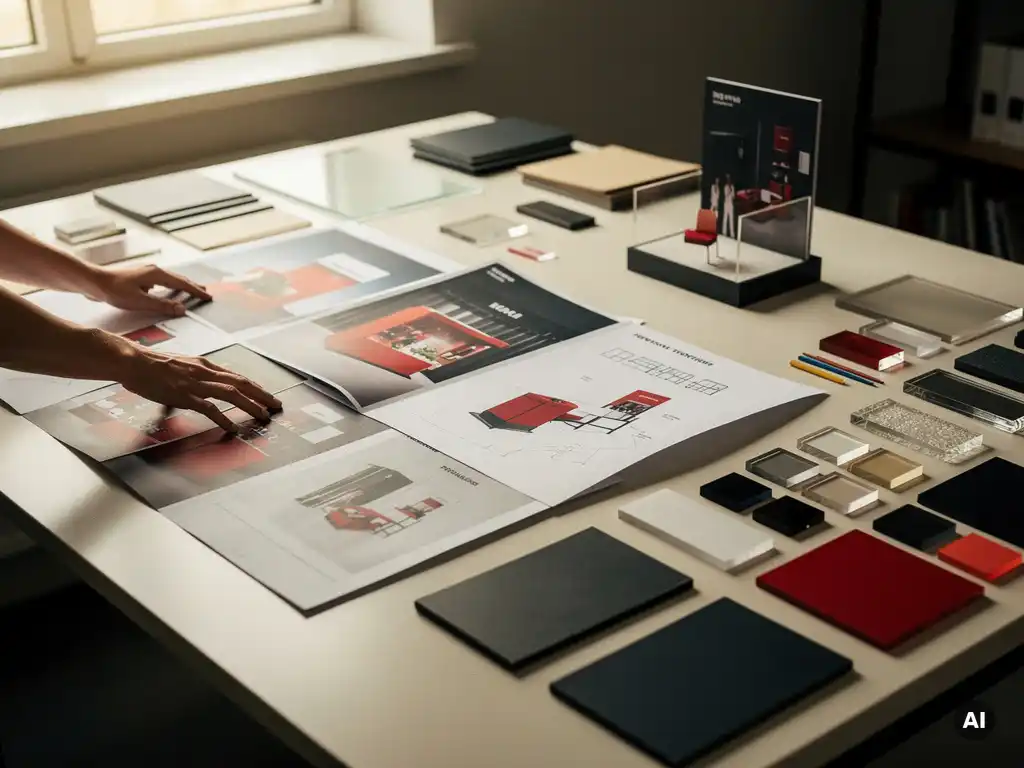
To brief a POS design agency effectively, provide a clear written document that covers your campaign objectives, target shopper profile, retail environment specifications, timeline, budget parameters, and any brand or retailer guidelines the agency must work within. The quality of a brief directly determines the quality of the creative response: a detailed, well-structured brief reduces revision cycles, protects budget, and gives the agency the foundation to deliver work that performs at the point of purchase. The sections below address the specific questions brand managers and marketing directors most commonly face when preparing a retail campaign brief.
Before a point of sale agency can begin concept development, it needs a clear picture of the brand, the campaign, the retail context, and the commercial goal. At minimum, this means brand guidelines, product information, retailer specifications, compliance requirements, and a defined objective. Without these inputs, any creative output is built on assumptions, and assumptions cost time and money to correct.
Agencies also need to understand the broader context: Is this a new product launch or a refresh of existing fixtures? Is the display permanent or temporary? Will it roll out across a single retailer or multiple channels? The more precisely a brand can answer these questions upfront, the more efficiently the agency can allocate design and production resource. A well-prepared briefing pack should consolidate all of this into a single reference document that the entire project team, design, account management, manufacturing, and installation, can work from.
Campaign objectives in a retail POS brief should be specific, measurable, and tied directly to shopper behaviour. Rather than stating a goal such as "increase brand visibility," define what success looks like in concrete terms, for example, driving trial of a new SKU, increasing basket size at fixture, or improving product discoverability within a particular category. Clear objectives allow the agency to make informed creative decisions at every stage.
Objectives also shape the design approach. A display intended to educate shoppers about a product's ingredients requires a different visual hierarchy than one designed to trigger an impulse purchase. Where possible, include any relevant sales data, previous campaign results, or shopper insight that informed the objective. This context allows a retail POS design team to align the creative strategy with the commercial outcome from the outset, rather than retrofitting messaging to a visual concept that has already been developed.
A retail campaign brief should specify the exact store environment where the display will be placed, including the retailer name, store format, fixture location within the store, available floor or shelf space, and any retailer-specific guidelines or approval processes. Dimensions, weight restrictions, and material requirements set by the retailer are non-negotiable constraints that must be communicated before design work begins.
The environment also includes less obvious factors that affect design decisions. Lighting conditions, foot traffic patterns, proximity to competing products, and the typical shopper dwell time in that zone all influence how a display should be structured. A pharmacy gondola end behaves very differently from a department store beauty counter, and a display optimised for one environment may be entirely unsuitable for the other. If the campaign spans multiple retail formats, note each one separately: a single display solution does not always translate across different retail contexts without adaptation.
Timelines are one of the most critical elements of any in-store campaign brief, and they are frequently underestimated. The brief should state the required in-store date and work backwards to identify the latest possible date for design sign-off, prototype approval, production commencement, and delivery. Each stage has a minimum lead time that cannot be compressed without affecting quality or cost.
Production lead times vary depending on the complexity of the display, the materials specified, and the volume required. A simple cardboard POS unit has a very different lead time from a permanent branded fixture involving metalwork, joinery, or acrylic fabrication. Retailers also impose their own delivery windows and booking-in procedures, which must be factored into the schedule. Including a clear timeline in the brief, with the in-store launch date prominently stated, allows the agency to flag any feasibility concerns immediately, before design investment has been made on a schedule that cannot be met.
A retail campaign brief should include a defined budget range for the total project, broken down by key cost areas where possible: design and development, prototyping, production, and installation. Providing a budget, even an indicative range, is not a negotiating weakness; it is the information an agency needs to propose a solution that is actually deliverable within the client's commercial parameters.
Without budget guidance, an agency may invest significant design resource in a concept that exceeds what the client can spend, or propose an overly conservative solution when greater investment was available and justified. Be transparent about any cost constraints specific to the campaign, for example, whether prototyping costs must be contained within the overall budget, or whether the unit cost per store has a hard ceiling. Where sustainability is a priority, note this alongside the budget, as material choices and manufacturing methods carry different cost implications that are better addressed at brief stage than during production.
A POS brief is easy to act on when it is specific, consolidated, and free of internal contradictions. The most actionable briefs include a single point of contact with authority to approve decisions, a clear hierarchy of objectives, all mandatory constraints stated upfront, and reference materials, such as brand guidelines, retailer specs, and product imagery, attached or linked in one place. Ambiguity at brief stage becomes costly at production stage.
Practical clarity matters as much as creative direction. State explicitly what the agency must not do, whether that relates to brand colours, materials, retailer rules, or budget lines, so that creative energy is directed within the right parameters from the start. Include examples of previous work that performed well, and if relevant, work that did not, with a brief note on why. This gives the agency a calibrated understanding of the brand's standards and the retailer's expectations without requiring multiple rounds of briefing calls.
Pivotal works with brand owners and marketing directors to translate retail campaign briefs into physical in-store experiences, from initial concept through to manufactured display and on-site installation. As a full-service point of sale agency, Pivotal's value lies in managing the entire project lifecycle under one roof, which removes the coordination risk that comes with using multiple suppliers across design, production, and installation.
If you are preparing a retail campaign brief and want to work with an agency that can take it from concept to installed fixture, speak to the Pivotal team to discuss your project requirements.