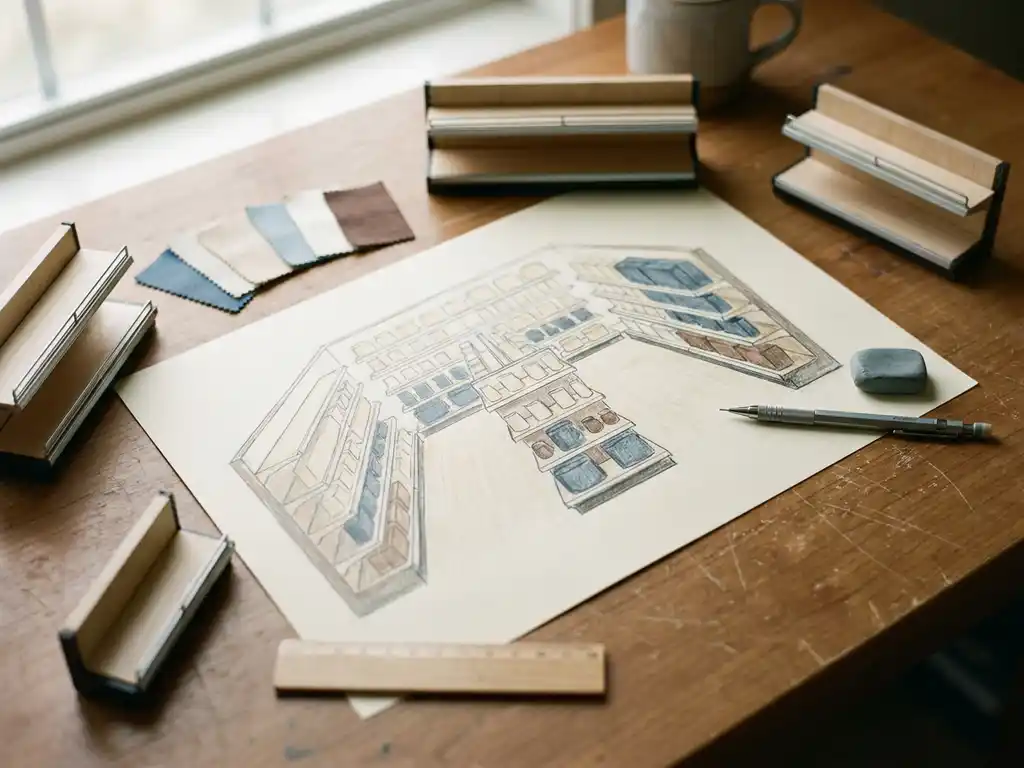
To create an effective planogram, start by mapping your product assortment to shopper behaviour, category hierarchy, and fixture dimensions — then translate that logic into a clear shelf layout that guides the eye, drives conversion, and supports replenishment. An effective planogram is not simply a diagram of where products sit; it is a strategic merchandising tool that aligns brand objectives with the physical realities of the retail environment. The sections below address the key questions retail and brand teams face when building, briefing, and evaluating planogram design.
What elements make a planogram effective?
An effective planogram combines product logic, visual hierarchy, and shopper flow into a structured shelf layout that drives purchase decisions at the point of sale. The most impactful planograms account for eye-level placement, category adjacencies, facing counts, and the physical dimensions of the fixture — ensuring the display works both commercially and visually.
The core elements that determine whether a retail planogram performs include:
- Eye-level placement: Products with the highest margin or strongest conversion rate should occupy the prime eye-level zone, typically between 1.2m and 1.7m from the floor.
- Logical flow: Shoppers read shelves in a broadly left-to-right pattern. Grouping by need, variant, or usage occasion reduces friction and supports cross-selling.
- Facing count: Insufficient facings reduce visibility and create an out-of-stock risk. Balancing facing allocation against velocity data is fundamental to planogram design.
- Clear signage and POS integration: In-store display elements such as shelf strips, header cards, and price communication should be built into the planogram from the outset, not added as an afterthought.
- Fixture compatibility: A planogram must account for the exact dimensions of the gondola, wall unit, or freestanding display it occupies. Misalignment between the plan and the physical fixture is one of the most common causes of failed installation.
Planogram tips that consistently improve performance include keeping the layout simple enough for store teams to maintain accurately, and ensuring that any temporary or permanent display solution is designed to accommodate replenishment without disrupting the visual presentation.
How do shopper behaviour insights shape planogram decisions?
Shopper behaviour insights directly determine how products are sequenced, grouped, and presented within a planogram. Understanding how shoppers navigate a category — their dwell time, decision triggers, and purchase journey — allows brand and retail teams to build shelf layouts that reduce friction and increase conversion at the point of purchase.
Key behavioural factors that inform planogram decisions include:
- Purchase mission: A shopper on a routine replenishment mission navigates differently from one discovering a category for the first time. Planograms should account for both, with clear navigation for habitual buyers and engaging presentation for new shoppers.
- Dwell time data: Categories with short dwell times require immediate clarity. High-consideration categories benefit from a layout that supports comparison and exploration.
- Basket affinity: Products frequently purchased together should be positioned in proximity where fixture design allows, reinforcing cross-sell opportunities.
- Brand blocking versus vertical segmentation: Shopper research consistently shows that brand blocking (grouping all SKUs from a single brand together) aids recognition, while vertical segmentation by variant or format aids navigation. The right approach depends on the category and the shopper's dominant decision driver.
Incorporating shopper insights at the briefing stage — rather than retrofitting them after a layout has been drawn — produces planograms that are far more likely to deliver measurable uplift in retail merchandising performance.
What's the difference between a temporary and permanent planogram?
A temporary planogram is designed for a fixed promotional period and is typically supported by short-term display materials such as seasonal POS, promotional bays, or campaign-specific fixtures. A permanent planogram defines the standard shelf layout for an ongoing category range and is built around fixtures intended to remain in place for an extended period, often one to three years or longer.
The distinction matters because it determines the materials, manufacturing approach, and level of investment appropriate for the display solution:
- Temporary planograms prioritise speed of deployment, ease of installation, and cost efficiency. They are often used to support new product launches, seasonal campaigns, or promotional activations. The supporting display materials are typically lighter-weight and designed for straightforward installation and removal by store staff.
- Permanent planograms justify higher investment in fixture quality, material specification, and bespoke design. They form the backbone of a brand's in-store presence and must withstand daily shopper interaction, regular replenishment, and ongoing compliance requirements.
In practice, many brands operate both simultaneously — a permanent fixture providing the structural category presence, with temporary POS layered over it to communicate current promotions. Designing these two layers to work together from the outset produces a more coherent in-store display and reduces the operational burden on store teams.
How do you brief a retail design partner on planogram requirements?
An effective brief for a retail design partner on planogram requirements should cover the fixture dimensions, product assortment, brand guidelines, retailer compliance rules, installation timeline, and the commercial objective the planogram is expected to deliver. The more precise the brief, the more efficiently the design and development process moves from concept to installation.
A well-structured planogram brief should include:
- Fixture specifications: Exact dimensions, bay width, shelf depth, and any retailer-mandated constraints on fixings or materials.
- Full product assortment: SKU list with dimensions, weight, and pack format for every product to be ranged. This is essential for accurate CAD development.
- Brand and retailer guidelines: Any restrictions on colour, material, logo placement, or POS format imposed by the retailer or the brand's own standards.
- Commercial priorities: Which products should receive priority placement, and what the key conversion objective is — whether that is driving trial, supporting a hero SKU, or increasing basket size.
- Installation requirements: Store count, rollout timeline, and whether installation will be managed by the design partner or by store teams.
- Sustainability requirements: Material preferences, recyclability targets, or any environmental commitments that should be reflected in the display solution.
Providing this information upfront allows a retail design partner to develop concepts that are commercially grounded, technically accurate, and executable at scale — avoiding costly revisions later in the process.
How do you measure whether a planogram is working?
A planogram is working when it demonstrably improves sales velocity, reduces out-of-stock incidents, and supports accurate in-store compliance across all locations. Measurement should combine sales data analysis with on-the-ground compliance auditing to form a complete picture of planogram performance.
The most reliable indicators of planogram effectiveness include:
- Sales uplift by SKU: Comparing sales velocity before and after a planogram change, at both product and category level, provides direct evidence of commercial impact.
- Compliance rate: A planogram that is not executed correctly in-store cannot be evaluated fairly. Regular compliance audits — ideally conducted by field teams with photographic evidence — confirm whether the layout is being maintained as designed.
- Out-of-stock frequency: A well-designed planogram accounts for replenishment cycles and facing counts. A rise in out-of-stock incidents following implementation may indicate that facing allocation or shelf depth has been miscalculated.
- Shopper engagement metrics: Where technology allows, dwell time and interaction data from in-store analytics can provide insight into whether the display is attracting and holding shopper attention.
- Retailer feedback: Store managers and category buyers will often identify practical issues with a planogram that are not visible in sales data alone — particularly around replenishment difficulty or shopper confusion.
Measurement should be treated as an ongoing process rather than a one-time evaluation. Planograms that are reviewed, refined, and updated in response to performance data consistently outperform those that remain static.
How Pivotal helps with planogram design and in-store display
Pivotal is a full-service retail design partner that takes planogram requirements from initial brief through to manufactured display and on-site installation. For brand owners and retail experience managers looking to strengthen their in-store presence, Pivotal provides:
- Bespoke concept development and CAD, grounded in shopper behaviour and retailer compliance requirements
- End-to-end manufacturing across acrylic, joinery, metalwork, and moulding — all produced to exact fixture specifications
- Nationwide installation carried out by Pivotal's own employed fitters, with over 2,000 retail and brand experiences installed in 2025
- Rapid prototyping to test and validate display solutions before full rollout
- Ongoing compliance support to ensure planogram integrity is maintained across all locations
Whether you are launching a new product range, refreshing an existing fixture, or building a permanent category presence in a major retailer, Pivotal delivers the precision and expertise to make it work in the real world. Explore Pivotal's retail design services or get in touch with the team to discuss your planogram requirements.