
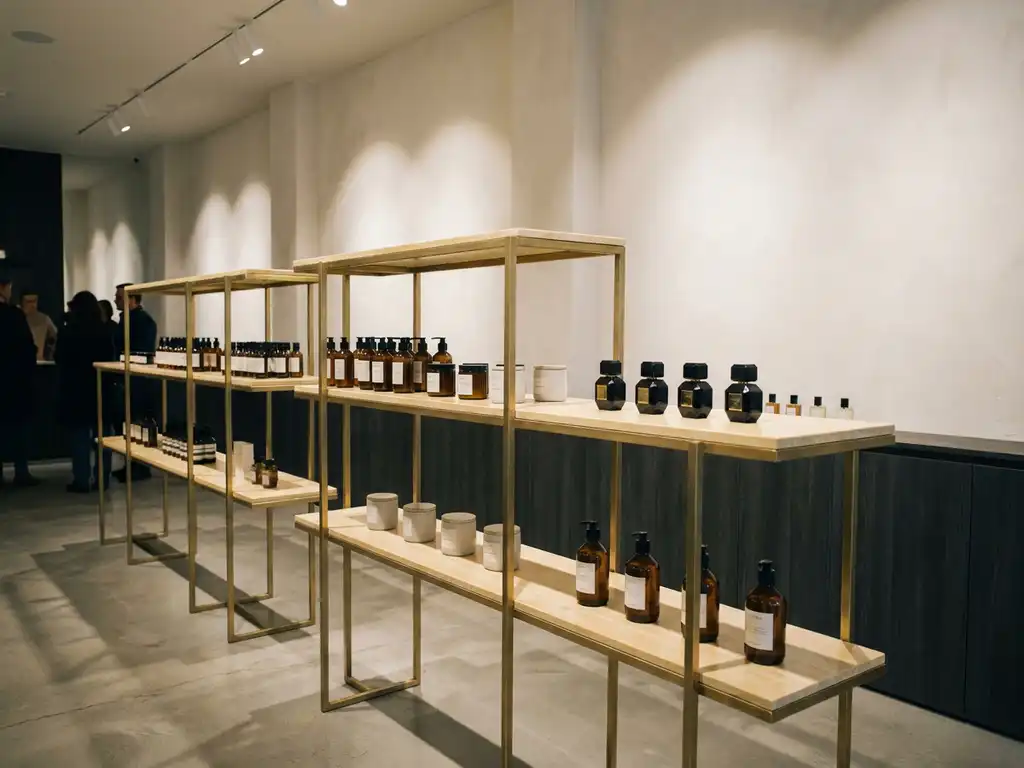
Designing a display unit that works across multiple retailers requires a modular, adaptable approach built on a single core structure that can flex to meet each retailer's space, guidelines, and shopper environment. The key is to resolve brand consistency and structural integrity at the design stage, so that adaptation downstream becomes a controlled process rather than a reactive one. The questions below address each layer of that challenge in turn.
The biggest challenges of designing a multi-retailer display unit are reconciling conflicting retailer specifications, maintaining brand consistency across different store formats, and managing production complexity without inflating cost or lead time. Each retailer operates its own planogram logic, fixture standards, and compliance requirements, which means a single display solution must be engineered to accommodate genuine variation from the outset.
Beyond the technical constraints, there are commercial pressures to consider. Brands need a display that performs at the point of purchase regardless of whether it sits in a pharmacy, a department store, or a supermarket. The shopper journey differs significantly between these environments, and a unit that drives conversion in one setting may underperform in another if the design has not accounted for differences in footfall patterns, dwell time, and shelf adjacency.
Managing the rollout itself also presents logistical complexity. Coordinating manufacturing, delivery, and installation across multiple retail partners simultaneously demands precise project management and a supply chain that can respond to last-minute changes without compromising quality or compliance.
Retailer guidelines directly constrain the physical dimensions, materials, fixings, and placement of any in-store display unit. Most major retailers issue detailed technical briefs specifying maximum height and footprint, approved fixing methods, weight limits, and in some cases, preferred suppliers for certain components. Ignoring or misreading these requirements at the design stage results in costly revisions or outright rejection at the compliance stage.
Guidelines also extend to visual and brand presentation. Some retailers restrict the proportion of branded graphics relative to product visibility, or mandate specific shelf labelling formats. Others have sustainability requirements that affect material choices, particularly around single-use plastics or non-recyclable finishes.
The practical implication is that multi-retailer display unit design must begin with a thorough audit of each retailer's guidelines before a single concept is committed to CAD. Where guidelines conflict, the design team must identify which constraints are absolute and which have flexibility, then engineer a modular solution that satisfies all mandatory requirements without producing an entirely separate unit for each retailer.
A modular display unit is a retail fixture built from a system of interchangeable components that can be configured, scaled, or adapted without redesigning the structure from scratch. Rather than producing a bespoke unit for each retailer, a modular approach establishes a core platform that accepts variable elements such as shelf heights, graphic panels, header cards, and base configurations to meet differing retailer requirements.
For multi-retailer rollouts, this approach delivers three significant advantages. First, it reduces tooling and manufacturing cost by concentrating investment in a single structural system rather than multiple independent builds. Second, it compresses lead time, because adapted variants can be produced from existing components rather than requiring a full production cycle. Third, it simplifies compliance, since the core unit has already been engineered and tested to meet structural and safety standards.
Modular design also supports brand consistency. When the same structural language carries across every retailer environment, the brand's visual identity remains coherent even as the unit's configuration changes. Shoppers encounter a recognisable fixture regardless of which store they are in, which reinforces brand recall at the point of purchase.
Consistent brand identity across different store formats is maintained by separating the structural elements of a display unit from the brand expression elements, and treating the latter as a controlled, non-negotiable layer. Structural dimensions and configurations may vary by retailer, but colour, typography, material finishes, and graphic hierarchy should remain constant across every deployment.
This requires a clear brand standards document that travels with the project brief and governs every production decision. Colour matching must be specified in absolute terms, such as Pantone references or verified RAL codes, rather than approximate descriptions that leave room for interpretation during manufacturing. The same discipline applies to material finishes, where a specific texture or sheen on an acrylic panel can carry significant brand meaning that is easily lost if substituted without oversight.
Lighting, where used, is another variable that significantly affects how a brand reads in different retail environments. A display that looks premium under controlled showroom lighting may appear flat under the fluorescent overhead lighting common in pharmacy or supermarket settings. Designing for the actual ambient conditions of each retail environment, rather than an idealised setting, is essential to preserving brand integrity across formats.
Material selection should be adapted per retail environment rather than standardised across all retailers, provided that any variation remains within a defined palette that preserves the brand's visual and tactile identity. The physical demands placed on a display unit differ considerably between a high-footfall supermarket and a specialist beauty counter, and the material specification should reflect those differences in durability, maintenance, and aesthetic expectation.
In high-traffic environments, materials need to withstand frequent contact, cleaning, and restocking without showing visible wear. This typically favours robust substrates such as powder-coated steel, high-density board with protective laminate, or injection-moulded components that resist impact. In premium retail settings, the expectation shifts toward materials that communicate quality at close range, where acrylic, joinery, and considered metalwork finishes become more appropriate.
Sustainability criteria are also increasingly shaping material decisions. Many retailers now require evidence of responsible sourcing, recyclability, or reduced plastic content as a condition of approval. Designing a material specification that meets these requirements across all target retailers from the outset avoids the need for late-stage substitutions that can compromise both the aesthetic and the compliance position of the unit.
For a multi-retailer display unit, the manufacturing and installation process follows a structured sequence that begins with a single approved prototype, validated against the most demanding retailer specification in the rollout, before production scales across all variants. This prototype stage is critical: it confirms that structural, aesthetic, and compliance requirements are met before any volume commitment is made.
Once the prototype is signed off, production of retailer-specific variants runs concurrently where possible, with components that are common across all configurations manufactured in a single run to maximise efficiency. Retailer-specific elements, such as adjusted shelf configurations or variant graphic panels, are produced alongside and assembled to order.
Installation coordination is where multi-retailer projects most commonly encounter delays. Each retailer operates its own scheduling windows, access restrictions, and store-level compliance checks. Effective management of this stage requires a dedicated project management function with direct communication lines to each retailer's estate team, and installation operatives who are familiar with the specific requirements of each retail environment. In 2025, Pivotal's in-store engineers visited a store every 34 minutes and installed over 2,000 new retail and brand experiences, which reflects the operational scale required to deliver multi-retailer programmes without disruption to trading.
Pivotal provides an end-to-end solution for brands that need a single display unit to perform across multiple retail environments. As a full-service retail design partner, Pivotal manages every stage of the process under one roof, removing the coordination risk that comes with using multiple agencies or suppliers across a complex rollout.
If you are planning a multi-retailer display rollout and need a partner who can manage the full project lifecycle from concept to installation, get in touch with Pivotal to discuss your brief.