3D visualisation helps in retail display design by allowing brands, designers, and retailers to see a fully rendered, photorealistic representation of a display before any physical materials are cut, shaped, or assembled. It bridges the gap between a written brief and a finished product, making design intent visible, shareable, and refinable at a fraction of the cost of physical production. The sections below address the most common questions brands raise when considering 3D rendering as part of their retail display design process.
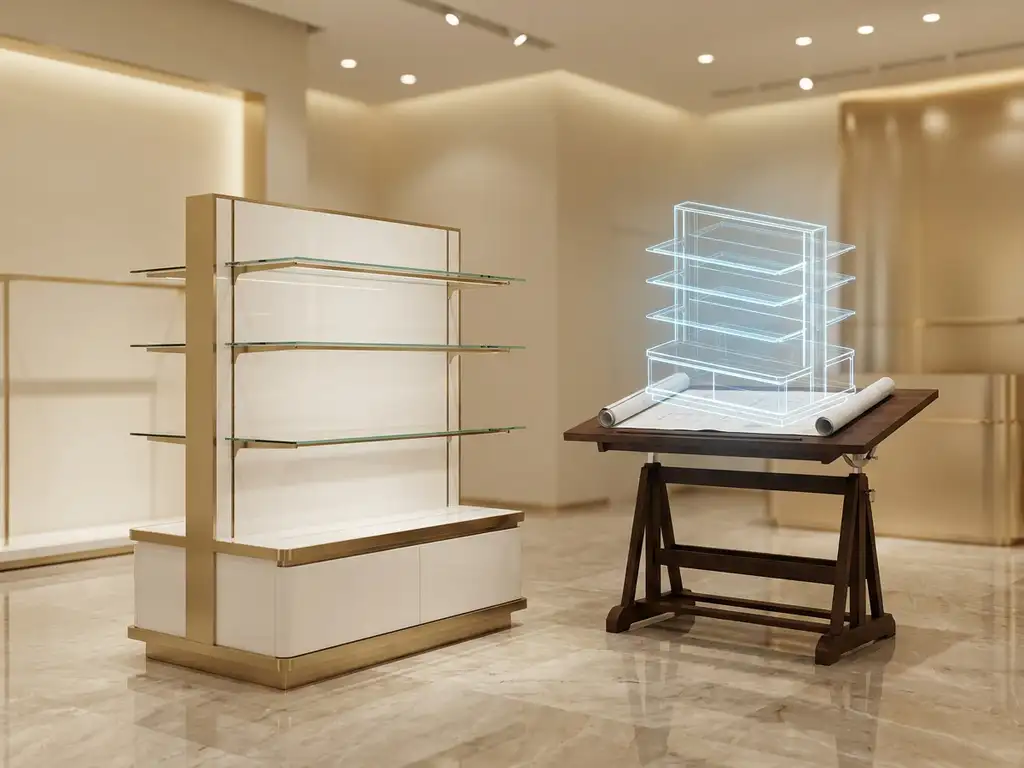
A 3D visualisation shows spatial relationships, material finishes, lighting effects, proportions, and brand graphics in context — all within a single rendered image. A sketch communicates intent; a 3D render communicates reality. Brands can assess how a fixture reads from shopper eye level, how colours interact under store lighting conditions, and whether the overall form aligns with their brand identity before committing to production.
Written briefs and hand-drawn sketches are valuable starting points, but they rely heavily on interpretation. Two stakeholders reading the same brief can picture entirely different outcomes. A 3D render eliminates that ambiguity. Designers can model the exact dimensions, specify surface textures such as brushed metal, gloss acrylic, or natural wood grain, and place the display within a virtual store environment that reflects the actual retail setting — whether that is a pharmacy aisle, a department store counter, or a supermarket gondola end.
This level of visual fidelity is particularly valuable when multiple stakeholders are involved in the sign-off process. Marketing directors, brand managers, and retail partners can all review the same image with a shared understanding of what the finished display will look like.
3D visualisation accelerates approval by replacing physical sample rounds with digital iterations that can be amended and redistributed within hours. Instead of waiting weeks for a prototype to be built, reviewed, revised, and rebuilt, stakeholders can review a rendered image, request changes, and receive an updated version rapidly — compressing what was once a multi-week process into days.
In retail display design, approval chains are often long. A brand's internal team, their retail partner, and sometimes a compliance team all need to sign off before production begins. Each round of physical prototyping adds cost and time. 3D rendering allows those rounds to happen digitally, so by the time a physical prototype is commissioned, the design has already been refined to a near-final state.
For brands working to tight campaign deadlines, such as seasonal launches or promotional windows, this compression of the approval timeline is a significant commercial advantage. Faster sign-off means faster production scheduling and a higher likelihood of hitting in-store installation dates.
Complex, multi-component displays benefit most from 3D visualisation in retail design. Permanent fixtures, branded counters, multi-tier free-standing units, and displays that incorporate lighting, digital screens, or mixed materials all carry higher design risk — and therefore gain the most from being fully modelled before manufacturing begins.
Simpler temporary displays with minimal components can often move through the design process with fewer visualisation rounds. However, even straightforward point of sale units benefit from 3D rendering when brand graphics are a central element, since the render allows teams to check graphic placement, scale, and legibility within the physical context of the display.
Displays intended for premium retail environments — such as beauty counters in department stores or skincare fixtures in pharmacy settings — particularly benefit from 3D visualisation because the aesthetic standard expected in those environments is high. Errors in finish, proportion, or material choice are far more visible in premium retail contexts, making pre-production visualisation an essential risk management tool.
3D visualisation reduces manufacturing errors by surfacing design conflicts, dimensional inaccuracies, and material incompatibilities at the digital stage, where corrections cost time rather than materials. Issues that would only become apparent during physical assembly — such as components that do not align, graphics that do not fit the panel dimensions, or structural elements that compromise the visual design — can be identified and resolved before a single component is produced.
Manufacturing errors in retail display production are costly. Material waste, rework, and delayed installation all carry direct financial consequences. When a display is fully modelled in 3D before production begins, the design file also informs more accurate CAD drawings and material specifications, reducing the likelihood of misinterpretation at the factory floor level.
For brands that operate across multiple retail locations, this accuracy is compounded. A dimensional error that goes undetected until installation means the same problem is replicated across every unit in the rollout. Catching it at the 3D stage prevents that multiplication of cost and disruption.
3D visualisation is a digital process that produces rendered images of a proposed display, while rapid prototyping is a physical process that produces a tangible model. Visualisation is used to refine design intent, gain stakeholder approval, and reduce risk before any physical production begins. Rapid prototyping produces a physical object that can be handled, tested for structural integrity, and assessed for material finish in real-world conditions.
The two processes are complementary rather than competing. In a well-structured retail display design workflow, 3D visualisation precedes rapid prototyping. The design is refined digitally until it reaches a state where all key stakeholders are aligned, and only then is a physical prototype commissioned. This sequence reduces the number of prototype iterations required, since the most significant design decisions have already been resolved at the digital stage.
Rapid prototyping adds value that 3D rendering cannot replicate: the weight of a material in hand, the tactile quality of a surface finish, the structural behaviour of a joinery detail under load. Both tools serve distinct purposes within the design and development process, and the most efficient projects use each at the appropriate stage.
A retail brand should request 3D visualisation as early as the concept development stage, before any structural drawings or material specifications are finalised. The earlier visualisation is introduced into the process, the greater its value — because design changes at the concept stage carry no production cost, while changes after manufacturing has begun carry significant cost and schedule risk.
Specifically, 3D visualisation is most valuable at three points in a project:
Brands that engage their display supplier at the earliest possible stage, rather than arriving with a finalised brief, are typically able to access the full value of 3D visualisation as a design tool rather than simply a presentation aid.
Pivotal is a UK-based, full-service retail design company that integrates 3D visualisation directly into its end-to-end display design and development process. For brands seeking a single partner to manage the full project lifecycle, Pivotal's approach offers a number of clear advantages:
Brands that work with Pivotal benefit from a joined-up process where the designer who creates the 3D visual is connected to the team that manufactures and installs the finished display. To discuss your next retail display project, or to explore how 3D visualisation can strengthen your in-store presence, get in touch with the Pivotal team today.