
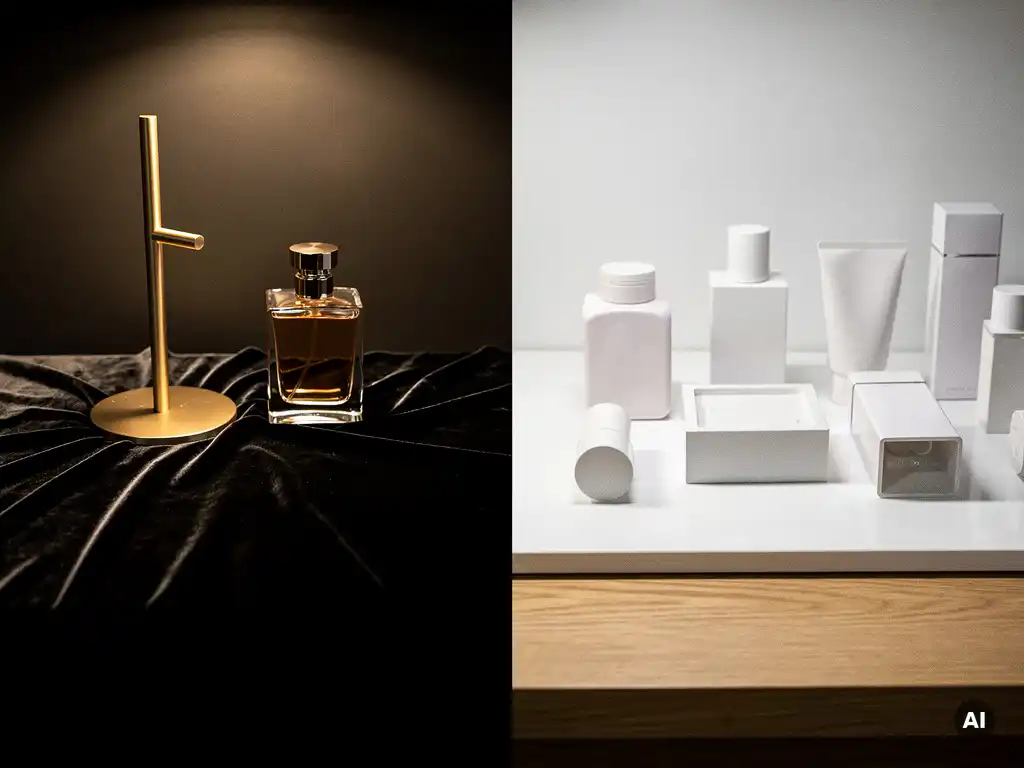
POS design changes fundamentally between luxury and mass-market retail because the two formats serve entirely different commercial objectives. Luxury point of sale design prioritises exclusivity, craftsmanship, and brand prestige, while mass-market retail display focuses on visibility, volume, and speed of decision-making at the shelf. The materials, finishes, psychology, and retail environments involved are distinct at every level. The sections below address each dimension in turn.
Luxury POS design is fundamentally different from the mass-market because it communicates brand value rather than product value alone. Where mass-market retail display is engineered to drive volume through clarity and accessibility, luxury point of sale design is engineered to create desire, signal status, and justify a premium price through the physical experience of encountering the brand.
In mass-market environments, the display must work quickly. Shoppers move fast, budgets are cost-sensitive, and the fixture needs to communicate the product's purpose and price within seconds. Every design decision is subordinate to function and efficiency.
In luxury retail, time is used differently. The display invites the shopper to pause, engage, and experience. The fixture itself is part of the product story. A poorly made display in a luxury context does not just fail aesthetically, it actively undermines the brand's positioning and can erode consumer trust in the product's quality.
Luxury retail displays typically use premium materials such as solid timber, brushed or polished metalwork, lacquered finishes, cast acrylic, leather, glass, and stone-effect surfaces. Mass-market displays rely more heavily on engineered board, injection-moulded plastics, corrugated card, and cost-effective laminates that prioritise durability and scalability over tactile quality.
The distinction is not simply aesthetic. Material choice in luxury POS design communicates permanence and investment. A brushed brass fixture in a department store beauty hall signals that the brand has committed to its presence. The weight, texture, and finish of the display become proxies for the quality of the product itself.
Mass-market materials are not inferior by accident, they reflect a rational commercial logic. When a brand needs to roll out displays across hundreds of supermarket or pharmacy locations simultaneously, cost per unit, ease of installation, and speed of production become the governing constraints. Corrugated POS and moulded plastic serve those requirements effectively.
For brands operating across both tiers, a beauty brand present in both a prestige department store and a high-street pharmacy, for example, material and finish decisions must be made deliberately for each channel. The same product can require two entirely different display strategies.
Shopper psychology in luxury retail is driven by aspiration, identity, and the desire for a curated experience, while mass-market shopper psychology is driven by recognition, convenience, and perceived value. These two motivational states require fundamentally different design responses at the point of sale.
In mass-market environments, the shopper is typically in a task-oriented mindset. They are navigating a busy store, making rapid comparisons, and responding to familiar visual cues: bold colour, clear price communication, and strong brand recognition. POS design in this context must interrupt that task-oriented flow just long enough to trigger a purchase decision.
In luxury retail, the shopper has often already decided to invest. The display's role is to confirm that decision, deepen the emotional connection to the brand, and elevate the moment of selection into something memorable. Lighting, spatial arrangement, and tactile interaction all contribute to that psychological effect.
Understanding these distinct motivational states is essential when briefing a retail design partner. A display that performs well in a mass-market pharmacy will not translate to a prestige beauty counter without significant redesign, not just in materials, but in the entire logic of how the shopper is expected to engage with it.
The retail environment is the single most influential factor in determining POS design requirements. Department stores, pharmacies, supermarkets, specialist boutiques, and exhibition venues each impose different spatial, regulatory, and brand expectations that must be resolved at the design stage.
Retailer-specific guidelines are a significant constraint in both luxury and mass-market contexts. Major UK retailers such as Boots operate strict approval processes for any branded fixture placed on their shop floor. Displays must meet dimensional, safety, and aesthetic standards before installation is permitted. Working with a retail design partner whose installation teams are retailer-approved removes a significant layer of project risk.
In department store environments, the luxury brand must compete for attention within a curated landscape of equally prestigious neighbours. The display must assert brand identity without conflicting with the store's own visual standards. In supermarket environments, the challenge is the opposite: the fixture must stand out within a high-volume, visually dense setting where shopper attention is fragmented.
Exhibition environments, such as brand activations at the NEC, introduce further requirements around portability, rapid assembly, and reuse across multiple events, factors that shape material choice, construction method, and overall design logic from the outset.
Sustainability considerations apply across both luxury and mass-market POS design, but the approach differs by context. Luxury displays tend to favour longevity, quality materials, and reduced replacement frequency as their sustainability argument. Mass-market displays, produced at higher volumes and shorter lifecycles, require more deliberate material choices, recycled substrates, responsibly sourced timber, and reduced plastic content, to manage environmental impact at scale.
For luxury brands, a permanent fixture crafted from durable, high-quality materials and designed to last several years carries a lower lifecycle environmental cost than a temporary display replaced seasonally. The sustainability case for premium materials is, in part, a case for permanence.
For mass-market brands, where temporary and semi-permanent POS is more common, the pressure to reduce single-use materials and improve end-of-life recyclability is significant. Brand owners and retailers alike are increasingly scrutinising the environmental credentials of their in-store display programmes, and suppliers who cannot demonstrate responsible material sourcing are at a competitive disadvantage.
Sustainability is no longer a secondary consideration in retail display design, it is a procurement criterion. Brands that integrate sustainability requirements into their POS brief from the outset achieve better outcomes than those who attempt to retrofit environmental credentials at the end of the design process.
A brand should invest in permanent POS when it has an established, long-term presence in a retail environment and requires a fixture that communicates brand authority, withstands high footfall, and justifies a higher unit cost through extended use. Temporary POS is the appropriate choice for product launches, seasonal campaigns, and promotional activations where the display's lifespan is defined by a specific commercial window.
The decision is not purely financial. Permanent fixtures in luxury retail serve a brand-building function that temporary displays cannot replicate. A well-designed permanent counter or branded bay signals commitment to the retail partnership and reinforces the brand's credibility with both the retailer and the shopper.
Temporary POS, by contrast, offers speed and flexibility. A brand launching a new product line needs a display solution that can be produced rapidly, installed across multiple locations within a defined campaign period, and removed efficiently at the end of that window. The design priorities are different, and so is the manufacturing brief.
Many brands operate both simultaneously, a permanent fixture anchoring their core range, supported by temporary promotional displays that drive attention to new or seasonal products. In these cases, the two display types must be designed to coexist coherently, sharing brand language while serving distinct commercial functions.
Pivotal is a UK-based, full-service retail design company that works with brands across both luxury and mass-market channels, managing the complete project lifecycle from initial concept through to on-site installation. For brand owners, marketing directors, and retail experience managers navigating the complexity of channel-specific POS design, Pivotal provides:
In 2025 alone, Pivotal installed over 2,000 new retail and brand experiences, with in-store engineers visiting a store every 34 minutes. Whether the requirement is a prestige permanent counter or a high-volume temporary promotional display, Pivotal has the capability to deliver it end to end. Contact the Pivotal team to discuss your next retail display project.