
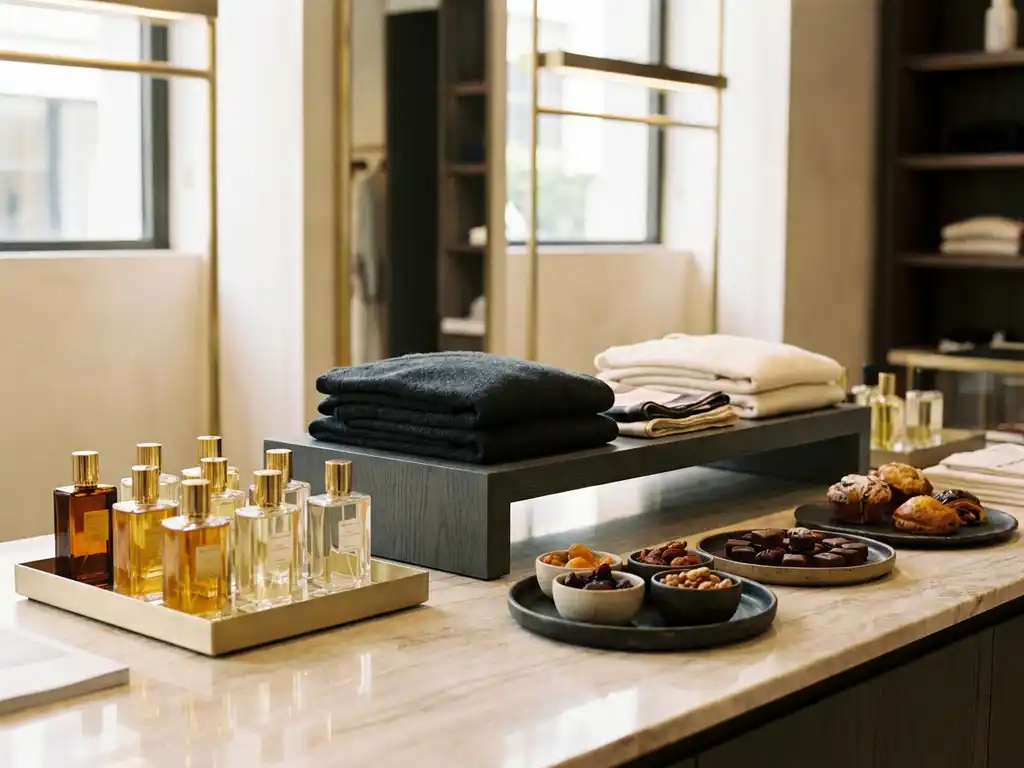
Retail display design differs significantly across beauty, fashion, and food categories because each category serves a distinct shopper psychology, operates within different retail environments, and demands different materials, formats, and compliance standards. Beauty displays prioritise tactile engagement and brand prestige; fashion prioritises spatial storytelling and flexibility; food and beverage prioritise hygiene, durability, and rapid product turnover. Understanding these differences is essential for any brand seeking to convert browsers into buyers at the point of sale. The sections below address the most common questions brands ask when briefing across these three categories.
Display design decisions are primarily driven by shopper behaviour, retail environment, product type, and the purchase trigger specific to each category. A beauty shopper is typically in a considered, exploratory mindset; a food shopper is often in a habitual or impulse-driven one; a fashion shopper responds to aspiration and lifestyle cues. Each of these states demands a fundamentally different physical response from the display.
Beyond psychology, practical constraints shape every brief. The footprint available in a pharmacy differs from a department store concession or a supermarket aisle. Fixture longevity requirements vary too: a temporary promotional display in a grocery environment may need to perform for six weeks, while a permanent beauty unit in a specialist retailer may be expected to last several years. Material selection, structural engineering, and graphic strategy all follow from these upstream decisions. Brands that approach retail display design without accounting for these category-specific variables often find that even well-produced displays underperform commercially.
Beauty retail displays are distinguished by their emphasis on brand prestige, sensory engagement, and product interaction. Unlike food or fashion, beauty shoppers frequently want to touch, test, and examine products before purchasing, which means the physical structure of the display must facilitate that behaviour while protecting the brand's visual equity. Lighting integration, premium material finishes, and testers are standard considerations in beauty in-store display design.
The retail environments in which beauty brands operate also create specific demands. Pharmacy environments such as Boots require displays that communicate clinical credibility alongside aesthetic appeal, particularly for skincare and dermatological brands. Department store concessions require a higher level of finish and brand immersion. In both cases, the display is not merely a product holder but an expression of brand identity operating in a competitive, visually dense environment.
Permanence is another distinguishing factor. Many beauty displays are semi-permanent or permanent fixtures, requiring materials and construction methods that withstand daily customer interaction over extended periods. Acrylic, powder-coated metalwork, and high-quality joinery are common in this category precisely because they maintain their appearance under sustained use. Brands investing in beauty retail displays should expect a higher specification brief and a longer development timeline than in other categories.
Fashion in-store displays are uniquely challenging because they must balance brand storytelling with operational flexibility across rapidly changing seasonal ranges. Unlike beauty or food, fashion product lines turn over frequently, which means display systems must be adaptable without requiring full replacement. A display designed for a summer capsule collection must be capable of being reconfigured or updated for the following season without compromising the brand's visual standards.
Spatial design is central to fashion display in a way that is less prominent in other categories. Fashion shoppers respond to how products are presented within a wider environment, including sight lines, adjacencies, and the relationship between fixtures and the surrounding store architecture. This makes fashion display design more closely related to shop fitting and interior design than a standard POS brief, and it demands close collaboration between the brand, the retailer, and the display designer from the outset.
Compliance with retailer guidelines adds a further layer of complexity. Major fashion retailers and department stores operate strict specifications for fixture dimensions, materials, and installation methods. Navigating these requirements while delivering a display that genuinely reflects the brand's identity requires both creative capability and deep operational experience.
Food and beverage displays prioritise hygiene-compliant, durable, and cost-effective materials because the retail environments they operate in are high-traffic, high-turnover, and subject to strict food safety standards. Unlike beauty or fashion, food and beverage POS displays are frequently temporary or semi-permanent promotional structures, designed to drive impulse purchase over a defined campaign period rather than to communicate long-term brand prestige.
Corrugated cardboard, food-safe plastics, and lightweight metalwork are common material choices in this category. These materials can be produced at volume, deployed rapidly across multiple store locations, and disposed of or recycled at the end of a campaign. The economics of food and beverage display design are therefore quite different from beauty: speed to market, cost per unit, and logistical scalability take precedence over premium finish.
Format choices also reflect the supermarket and convenience retail environment. Floor-standing display units, shelf-edge strips, dump bins, and header cards are standard formats because they integrate with existing fixture infrastructure and can be installed by store staff without specialist fitters. For brands operating in this category, the display brief is as much a logistics and compliance exercise as it is a creative one.
Despite the significant differences between beauty, fashion, and food display design, several core principles remain consistent across all three categories. Brand clarity, structural integrity, and shopper legibility are non-negotiable regardless of the retail environment or product type. A display that fails to communicate clearly, or that degrades quickly under normal retail conditions, will underperform in any category.
These shared principles mean that a strong retail display design partner can operate effectively across categories, applying category-specific knowledge within a consistent design and manufacturing methodology.
Brands should brief a retail display designer by providing category-specific context upfront, including the retail environment, the shopper occasion, the display's intended lifespan, and the compliance requirements of the host retailer. A brief that works for a beauty launch in a pharmacy will not translate directly to a food promotion in a supermarket, and attempting to apply the same brief template across categories will produce suboptimal results.
The most effective briefs address the following points with specificity:
Providing this information at the outset of a brief significantly reduces development time and ensures that the design process moves forward on accurate foundations rather than assumptions that require correction later.
Pivotal is a full-service retail display design and development partner working across beauty, fashion, food, and beverage categories. For brands navigating the complexity of category-specific display design, Pivotal provides a structured, end-to-end capability that removes the need to manage multiple suppliers across the project lifecycle.
Whether you are launching a new product line, refreshing existing fixtures, or entering a new retail channel, Pivotal's team brings the category knowledge and manufacturing capability to deliver. Explore our recent retail projects to see how we work across categories, or start a conversation with the Pivotal team to discuss your next display brief.