
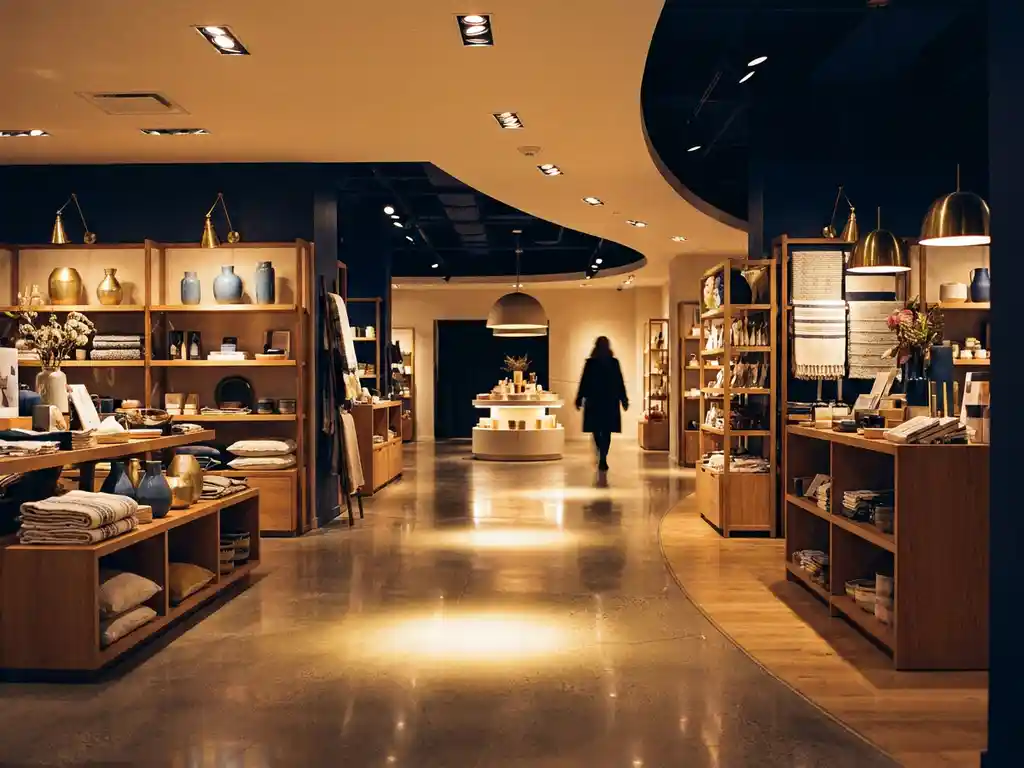
Shopper flow directly affects visual merchandising layout by determining which zones, aisles, and fixtures receive the highest footfall and dwell time. Displays placed in alignment with natural traffic patterns are seen by more shoppers and at the right moment in the decision-making journey. Understanding how customers move through a store is therefore a foundational requirement for any effective merchandising strategy.
For brand owners and retail experience managers, getting this relationship right translates into measurable commercial outcomes: stronger product visibility, higher conversion rates, and a more intuitive customer journey that retail environments depend on. The sections below address the most common questions surrounding shopper flow and how it should inform every merchandising decision.
Shopper movement patterns define the commercial value of every position within a store. High-traffic routes command premium placement for hero products and brand statements, while lower-traffic zones suit secondary ranges or supporting communication. A visual merchandising layout that ignores how customers actually move through a space risks placing key displays where they will never be seen.
Retail traffic flow analysis reveals that shoppers tend to decelerate at natural decision points: aisle junctions, category transitions, and areas where navigation requires a pause. These moments of reduced pace create ideal conditions for point of purchase display placements, because the shopper's attention is available and their intent to browse is highest.
The practical implication is that display placement should never be based on convenience or available floor space alone. It must be mapped against observed or modelled traffic data. A display positioned two metres into a high-traffic aisle will typically outperform an identical display tucked at the far end of a low-footfall section, regardless of how well the creative executes the brand message.
The most commonly observed shopper flow patterns in retail are the perimeter loop, the grid path, the free-flow circuit, and the racetrack. Each pattern emerges from a combination of store architecture, category placement, and shopper habit, and each creates distinct zones of high and low engagement that directly shape merchandising strategy.
Understanding which pattern governs a specific retail environment is essential before any in-store navigation or fixture strategy is finalised. The same display concept may need to be repositioned, rescaled, or reoriented depending on which flow model is in play.
The areas that consistently attract the most shopper attention are store entrances and decompression zones, end-of-aisle fixtures, eye-level shelving along primary traffic routes, and checkout areas. These locations benefit from either high footfall, natural deceleration, or both, making them the most strategically valuable positions for brand display and point of purchase activity.
The entrance decompression zone, typically the first few metres inside the door, is where shoppers transition mentally from outside to inside. This area often receives high footfall but low immediate engagement, as shoppers are still orienting themselves. Powerful brand statements and large-format displays work well here to build awareness without demanding immediate interaction.
Eye-level positioning along primary retail traffic flow routes remains one of the most reliable drivers of product interaction. Shoppers make rapid visual decisions, and products or displays placed at natural sightlines benefit from this without requiring any additional navigation effort from the customer.
End-of-aisle positions, known as gondola ends, combine high traffic exposure with the deceleration that occurs when shoppers turn corners or change direction. These locations are consistently among the most sought-after placements in category-managed retail environments.
Poor flow design reduces in-store conversion by creating friction in the customer journey, causing shoppers to miss key product placements, become disoriented, or abandon their browse before reaching purchase-critical zones. When the retail store layout works against natural movement patterns, even well-executed displays fail to deliver their commercial potential.
Common consequences of misaligned flow design include:
The commercial cost of these errors is significant. Reduced dwell time, lower basket size, and missed brand interaction all trace back to layouts that were designed without adequate shopper flow intelligence. For brands investing in bespoke display solutions, poor host environment flow can neutralise that investment entirely.
Retailers and brands use a combination of technology and observational research to measure shopper flow. The most widely deployed tools include footfall sensors, heat mapping technology, video analytics, RFID tracking, and structured shopper observation studies. Each method captures different dimensions of movement data, and the most accurate picture typically comes from combining more than one approach.
Footfall counters provide volume data at entry and exit points, while in-aisle sensors can track movement density across specific zones. Heat mapping overlays this data visually, making it straightforward to identify which areas attract sustained attention and which are consistently bypassed.
Video analytics have advanced considerably and can now capture dwell time, direction of travel, and even the point at which shoppers pause to engage with a fixture. This level of granularity is particularly useful when evaluating the performance of specific display placements or testing alternative merchandising layouts before a full rollout.
Shopper observation studies, conducted in live retail environments or controlled research settings, add qualitative depth that technology alone cannot provide. Understanding why a shopper pauses, picks up a product, or changes direction is as important as knowing that they did.
Visual merchandising layouts should adapt to changing shopper behaviour by treating flow data as a living input rather than a one-time design brief. As shopping habits evolve, driven by shifts in channel preference, category usage, and physical retail expectations, the displays and fixtures that serve those shoppers must evolve with them. Static layouts risk becoming misaligned with how customers actually navigate and engage in 2026.
Several behaviour shifts are actively reshaping how retail store layouts should be structured. Shoppers increasingly move between physical and digital touchpoints within a single purchase journey, meaning in-store displays must work harder to justify physical engagement. Layouts that support exploration, discovery, and tactile interaction are gaining ground over those designed purely for efficient navigation.
Flexibility is now a core design requirement. Modular fixture systems that can be reconfigured without significant cost or disruption allow brands and retailers to respond to seasonal shifts, new product launches, and emerging traffic data without committing to permanent layouts that may quickly become outdated.
Sustainability expectations are also reshaping material and construction choices within visual merchandising. Shoppers and brand owners alike are scrutinising the environmental credentials of in-store experiences, which means layouts must balance commercial performance with responsible design from the outset.
Pivotal works with brand owners and retail experience managers to ensure that display strategy is grounded in how shoppers actually move and engage in-store. As a full-service retail design partner, Pivotal brings together the expertise needed to translate shopper flow insight into commercially effective physical experiences:
Effective visual merchandising layout begins with understanding the shopper journey and ends with a physical execution that performs in the real retail environment. If you are ready to align your display strategy with how your shoppers actually behave, speak to the Pivotal team today.