
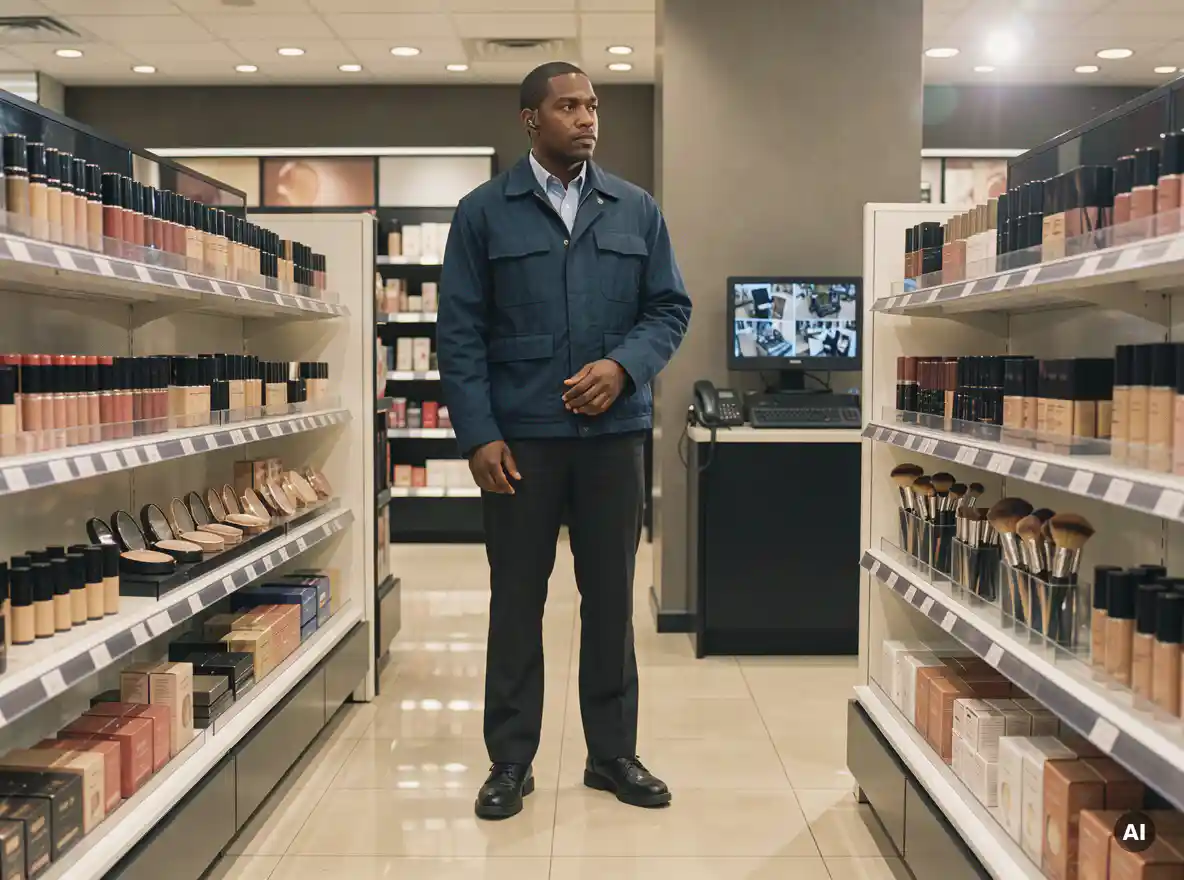
A retail loss prevention officer protects a store's stock, staff, and profit by monitoring shopper behaviour, enforcing security procedures, investigating incidents, and reducing shrinkage from theft, error, and fraud. Daily work combines floor patrols, camera surveillance, record keeping, and staff coordination. Understanding these duties helps brands and retailers align store environments with effective retail loss prevention.
A typical shift begins with a handover briefing, a review of overnight incidents, and a walk of the sales floor and stockroom, followed by continuous patrols and camera monitoring until closing checks and reporting are complete. Shift structure varies by store format, but the sequence is consistent across most UK retail environments.
Officers usually start by checking incident logs, confirming that CCTV and alarm systems are operational, and identifying high-risk product lines for the day. Delivery days, promotional launches, and peak trading periods change the plan, as these moments increase both stock movement and opportunities for theft.
Mid-shift activity centres on visible floor presence. A uniformed or plain-clothes officer moves through the store, deters opportunistic offenders, and supports colleagues with queries. The close of the shift typically includes cash office and fire exit checks, completion of incident reports, and a handover note for the next team.
Most of a loss prevention officer's time goes on floor patrols, CCTV monitoring, and documentation. Administrative work, including incident reports, evidence handling, and stock discrepancy checks, often consumes more hours than direct confrontation, which remains rare and tightly controlled.
The main task categories are:
Internal loss, including employee theft and till fraud, also forms part of the remit. Retail loss prevention covers the full shrinkage picture, not only customer theft.
Loss prevention officers spot shoplifters by recognising behavioural indicators, such as repeated glances at staff, concealment movements, and unusual interest in exits, then respond through observation, deterrence, and lawful intervention. Most incidents are resolved by visible presence and customer engagement rather than apprehension.
Officers look for patterns instead of single actions. Typical signals include loitering near high-value or small, easily concealed products, carrying large bags or coats unsuited to conditions, handling items while watching staff rather than the product, and removing packaging or security tags out of sight.
Intervention follows strict protocol. Officers must see the item selected, observe concealment, and confirm that the person has left without paying before any approach. Many retailers instruct officers to disengage if safety is at risk and to rely on footage and police reporting instead. Early, friendly customer service remains one of the most effective deterrents, as it signals that the store is attentive.
Store layout and display design directly influence theft by controlling sightlines, product accessibility, and shopper flow. Open sightlines, secure fixtures, and well-positioned high-value lines reduce concealment opportunities, while cluttered aisles and obstructed displays create blind spots that offenders exploit.
Several design factors matter most:
This is where security and commercial objectives meet. Beauty, health, and pharmacy categories are frequent theft targets, and the display that merchandises a product also determines how easily it can be taken. Effective retail loss prevention therefore begins at the design stage, not after losses appear.
A loss prevention officer needs observational awareness, calm communication, sound judgement, and a working knowledge of the relevant legal framework. In the UK, many roles require an SIA licence, particularly for door supervision or security guarding, while employers also value prior retail or security experience.
Core competencies include:
Formal qualifications are less decisive than reliability and composure. Employers assess whether an officer can remain discreet, follow procedure under pressure, and work effectively alongside store teams.
Retail loss prevention in 2026 increasingly relies on AI-assisted video analytics, electronic article surveillance, data-driven shrinkage analysis, and connected fixtures. These tools shift the officer's role from reactive observation toward predictive monitoring, while human judgement remains essential for decisions and interventions.
Key developments include video analytics that flag unusual behaviour in real time, exception-based reporting on till and refund activity, and body-worn cameras that support de-escalation and evidence capture. Self-checkout monitoring has also become a priority, as unscanned items remain a significant source of loss.
Physical solutions are advancing alongside digital ones. Smarter fixtures, integrated security tagging, and display systems designed with theft resistance in mind allow products to remain visible and accessible to genuine shoppers while limiting opportunistic removal. Technology performs best when combined with well-designed physical environments and consistent in-store upkeep.
Pivotal addresses retail loss prevention at the source: the physical store environment. As a full-service retail design company, Pivotal creates, makes, installs, and maintains displays and fixtures engineered to protect products without compromising shopper engagement. In 2025, Pivotal installed over 2,000 new retail and brand experiences, supported by its own employed fitters.
For brands and retailers seeking displays that protect margins as well as drive conversion, Pivotal provides a single, accountable partner from concept to installation and beyond. Contact Pivotal today to discuss a display strategy that strengthens both your in-store presence and your loss prevention results.