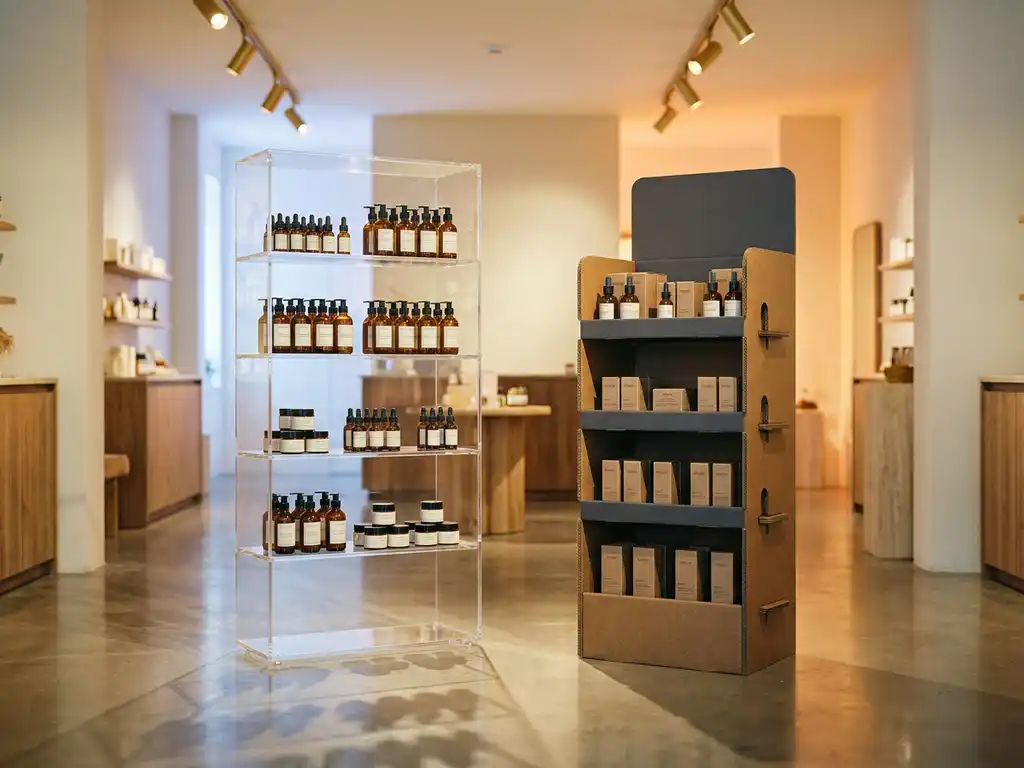
Permanent retail displays are fixed, long-term fixtures designed to remain in-store for an extended period, typically one year or more, while temporary retail displays are short-term structures built to support a specific campaign, promotion, or seasonal period before being removed or replaced. The distinction matters commercially because each type serves a different strategic purpose, requires a different level of investment, and suits different product categories and retail environments. The questions below unpack every practical dimension of that difference.
Permanent retail displays are best suited to products with consistent, year-round demand that justify a sustained in-store presence. Core product ranges, hero SKUs, and category-defining items benefit most from a fixed display because the investment in design, materials, and installation is spread across an extended period of shopper engagement.
In practice, this means established skincare brands, pharmacy essentials, premium beauty lines, and flagship fashion accessories are strong candidates for permanent fixtures. These are products where brand visibility at the point of purchase directly influences repurchase behaviour, and where a well-designed display builds brand equity over time rather than serving a single activation.
Permanent displays also work well for brands that hold a dedicated space within a retailer, such as a branded bay or countertop unit in a department store or pharmacy. The fixture itself becomes part of the brand's retail identity, reinforcing recognition every time a shopper passes. For brands in sectors such as health, wellness, and premium beauty, this kind of consistent physical presence is a measurable commercial asset.
The primary material difference between permanent and temporary retail displays is durability. Permanent displays are constructed from robust, long-lasting materials such as metal, solid wood, joinery, acrylic, and engineered composites, while temporary displays typically use lighter materials such as corrugated card, foamboard, lightweight plastics, or short-run laminates that are cost-effective to produce and straightforward to dispose of after use.
For permanent fixtures, material selection is guided by longevity, finish quality, and the ability to withstand daily shopper interaction. Metalwork and joinery provide structural integrity, while acrylic and moulded components allow for premium aesthetic finishes that hold their appearance across months of use. These materials also support more complex forms, integrated lighting, and branded detailing that elevates the in-store experience.
Temporary displays prioritise speed of production and cost efficiency. The materials are chosen to be printable, lightweight, and easy to assemble in-store without specialist installation. While they can achieve strong visual impact through bold graphics, they are not designed to endure the same level of wear. Sustainability considerations are increasingly influencing material choices at both ends of the spectrum, with recyclable and responsibly sourced materials becoming a standard expectation rather than an optional extra.
A permanent retail display is designed to last anywhere from one to five years or more, depending on materials, usage levels, and the retailer's refresh cycle. A temporary display, by contrast, is typically built for a lifespan of days to three months, aligned to a promotional window, seasonal campaign, or product launch period.
The longevity of a permanent display depends heavily on build quality and the retail environment it operates in. A high-traffic pharmacy fixture experiences significantly more wear than a display in a boutique environment, and material and finish choices should reflect that. Well-maintained permanent fixtures can outlast their expected lifespan considerably, particularly when a maintenance programme is in place to address minor damage before it compounds.
Temporary displays are not designed to be maintained. Their value lies in speed to market and visual freshness during a defined period. Once the campaign ends, the display is removed and typically recycled or disposed of. This short lifecycle is a deliberate design choice, not a limitation, and it makes temporary displays the appropriate tool for time-sensitive activations where flexibility outweighs longevity.
A brand should choose a temporary retail display when the objective is time-limited, such as a product launch, seasonal promotion, event tie-in, or trial activation. Temporary displays are the right tool when speed, flexibility, and cost efficiency matter more than longevity, or when the brand does not yet have a confirmed long-term space within a retailer.
There are several scenarios where temporary displays are the strategically correct choice:
The decision is ultimately commercial. If the display's purpose ends when the promotion ends, temporary is the right format. If the display is intended to build sustained brand presence, a permanent fixture delivers better long-term return on investment.
Permanent retail displays carry a higher upfront production cost than temporary displays due to the quality of materials, complexity of construction, and the installation process involved. Temporary displays are lower in unit cost but may require more frequent replacement, which can erode the cost advantage over time if campaigns run repeatedly.
The cost of a permanent display reflects its build specification. Metalwork, joinery, acrylic fabrication, and professional installation by employed fitters all contribute to the investment. However, when that cost is amortised across a lifespan of two to four years, the cost per week of in-store presence is often lower than a series of temporary displays covering the same period.
Temporary displays are typically produced at lower per-unit cost, which makes them accessible for shorter runs and test activations. However, brands running multiple seasonal campaigns annually may find that cumulative temporary display spend approaches or exceeds the cost of a well-specified permanent fixture. A thorough cost-per-activation analysis, factoring in design, production, logistics, and disposal, is the most reliable basis for this decision.
Yes. A retail display can be designed with a hybrid structure that combines a permanent base unit with interchangeable temporary elements, allowing the core fixture to remain in place while seasonal graphics, promotional headers, or campaign-specific components are updated regularly. This approach delivers the consistency of a permanent display with the flexibility of a temporary one.
Hybrid display systems are increasingly common among brands that hold a fixed space within a retailer but need to refresh their in-store messaging throughout the year. The permanent chassis, built from durable materials such as metal or engineered wood, provides structural integrity and brand consistency. Temporary graphic panels, clip-in headers, or modular shelf units can then be swapped out to reflect new campaigns without replacing the entire fixture.
This model also offers a more sustainable approach to in-store display, reducing material waste by extending the life of the core structure. For brands managing multiple retail environments across different retailers or regions, a well-engineered hybrid system simplifies logistics and reduces the total cost of ownership over time.
Pivotal works with brands across the full spectrum of retail display design, from permanent fixtures to temporary campaign structures and hybrid solutions. The decision between permanent and temporary is never one-size-fits-all, and Pivotal's end-to-end service is built to guide that decision with precision.
Whether the objective is a long-term branded fixture, a high-impact seasonal activation, or a hybrid system that does both, Pivotal delivers the commercial outcome. Connect with the Pivotal team to discuss your next in-store display project.