
POS (point of sale) and POP (point of purchase) displays are related but distinct tools in retail marketing. POS displays are positioned at or near the checkout, targeting shoppers at the final moment of purchase. POP displays are placed throughout the store, closer to where buying decisions are made, typically at the shelf, aisle end, or product zone. Both serve different strategic functions within the same retail environment. The questions below unpack each format in detail, compare their conversion impact, and guide brands on when and how to deploy them effectively.
POS displays operate at the checkout or payment area, where a shopper has already committed to buying and is receptive to last-minute additions. POP displays work earlier in the journey, intercepting the shopper while they are still browsing and evaluating options. The core difference is timing: POP influences the decision, POS capitalises on it.
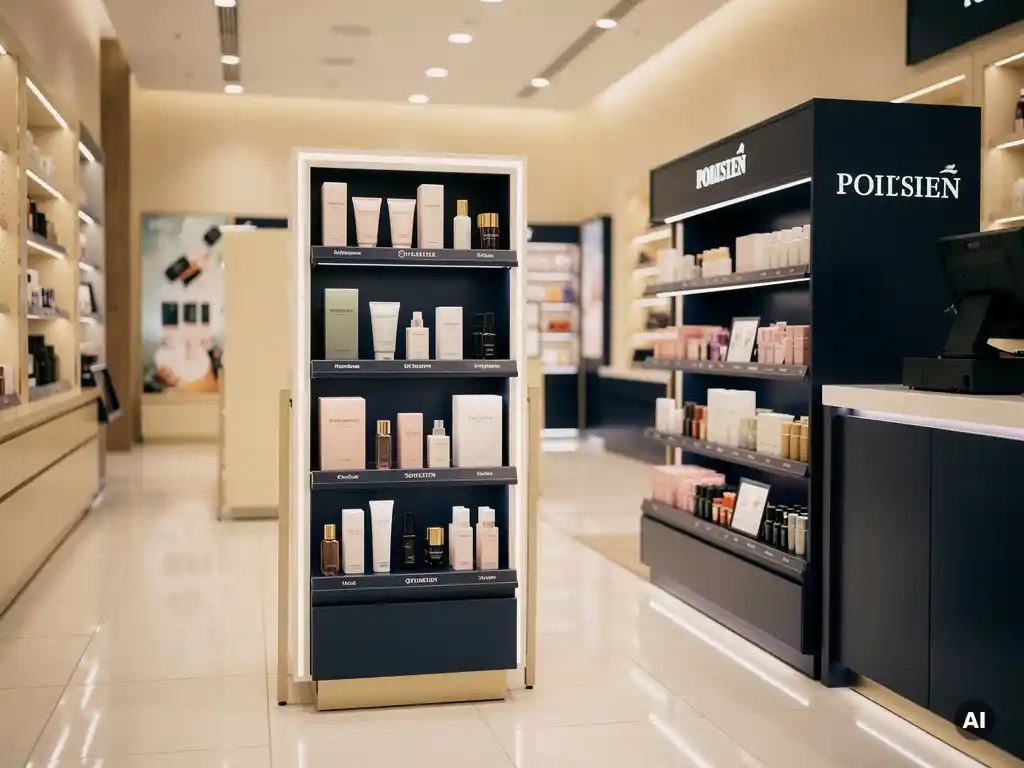
In practical terms, a point of sale display might feature impulse-buy products, travel-size items, confectionery, or promotional accessories, positioned to encourage an unplanned addition to the basket. A point of purchase display, by contrast, might be a freestanding unit at the end of a pharmacy aisle presenting a full skincare range, designed to educate the shopper and drive a considered purchase.
Both formats rely on strong visual communication, structural integrity, and brand consistency. The best-performing displays in either category are purpose-built for their location, not repurposed from another context. Understanding this distinction is the starting point for any effective retail display strategy.
In UK retail, POS displays are any branded fixtures or units placed at or immediately adjacent to the checkout or payment point. Common formats include countertop units, dump bins, spinner racks, and small freestanding displays positioned within the checkout queue or at the till itself.
The defining characteristic of a POS display is its location relative to the transaction. Formats typically used as retail POS in the UK include:
In pharmacy and health retail environments, such as Boots or independent chemists, POS displays frequently feature skincare, supplements, and travel essentials, where the checkout presents a natural opportunity for brand owners to capture incremental sales.
The most common POP display formats in UK retail are freestanding display units (FSDUs), shelf-edge displays, aisle fins, pallet displays, and gondola end units. These formats are designed to interrupt the shopper's path through the store and draw attention to a product or range before the buying decision is finalised.
Each format serves a specific purpose within the store environment:
Temporary and permanent in-store displays each have their place. Temporary POP structures support campaign activity and new launches; permanent fixtures build brand equity over time and reinforce retail partnerships.
Neither POS nor POP displays universally outperform the other, conversion impact depends on the product category, purchase journey, and placement strategy. POP displays typically drive higher conversion for considered purchases by interrupting the decision-making process at the right moment. POS displays excel at driving impulse additions, particularly for low-cost, high-margin products.
For beauty, health, and wellness brands, POP displays placed in the relevant product aisle or a dedicated brand zone tend to generate stronger category engagement, because the shopper is already in the mindset to browse and compare. The display has the opportunity to educate, demonstrate, and differentiate.
POS displays perform most effectively when the product is familiar, low-risk, and priced for impulse. A shopper who has never encountered a product before is unlikely to commit to it at the checkout without prior exposure, which is precisely why POP and POS work best as part of a coordinated strategy rather than in isolation.
The quality of the display itself is also a significant conversion variable. A structurally sound, visually compelling unit that holds stock correctly and remains compliant throughout its deployment will consistently outperform a poorly executed one, regardless of its location in-store.
A brand should use POP displays when the objective is to drive discovery, educate the shopper, or differentiate within a category. POS displays are the right choice when the goal is to capture incremental spend at the point of payment. Using both simultaneously delivers the strongest results when a brand has the budget and retail space to support a coordinated campaign.
Practical decision-making criteria include:
For brands managing national rollouts across multiple retail environments, aligning POS and POP strategy with retailer-specific requirements is essential. This is where working with an experienced retail display partner, one with established retailer relationships and compliance knowledge, adds measurable value.
When evaluating a retail display supplier in the UK, brands should ask whether the supplier manages the full project lifecycle, from design and prototyping through to manufacturing, installation, and compliance. A supplier who handles only part of the process introduces coordination risk and reduces accountability across the project.
Key questions to put to any prospective supplier include:
The answers to these questions reveal whether a supplier can genuinely operate as a strategic partner or simply a production vendor. For brands investing in physical retail presence, the distinction matters significantly.
Pivotal is a UK-based, full-service retail display partner that manages every stage of the display process, from initial concept and CAD through to manufacturing, installation, and ongoing maintenance. For brands seeking clarity on how to deploy POS and POP displays effectively, Pivotal offers:
Whether a brand needs a single campaign FSDU or a coordinated POS and POP rollout across hundreds of locations, Pivotal provides the end-to-end capability to deliver it with precision. Contact Pivotal today to discuss how a tailored retail display strategy can strengthen your in-store presence and drive measurable conversion.