
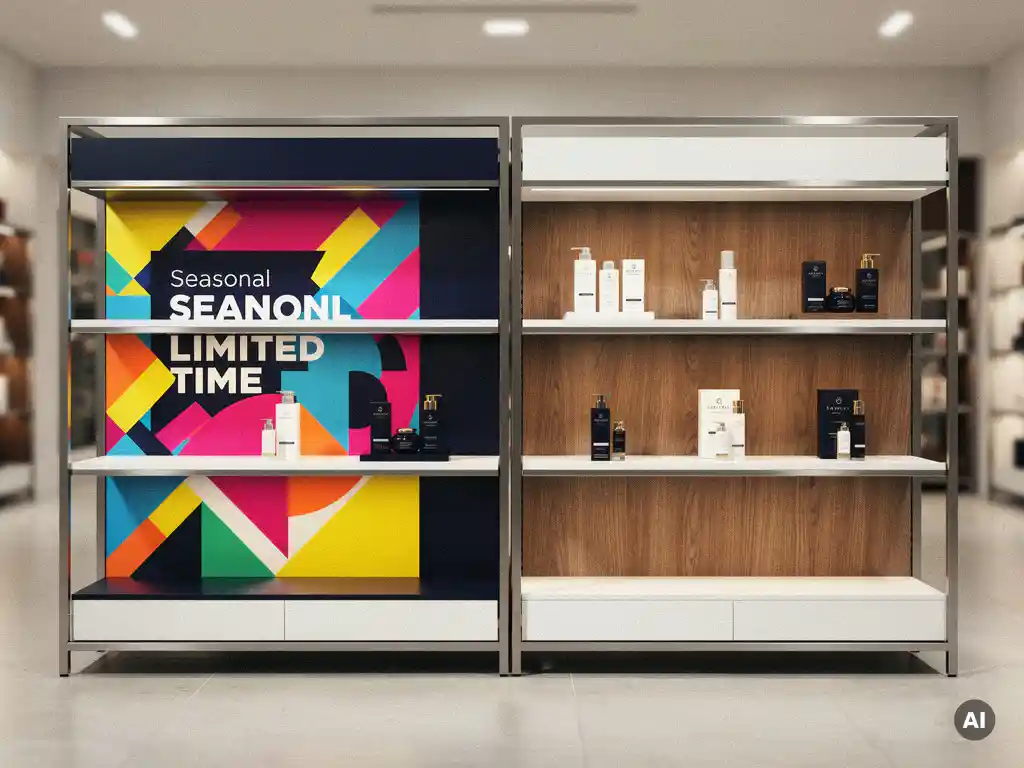
Promotional POS and evergreen POS serve fundamentally different commercial purposes. Promotional point of sale displays are temporary, campaign-specific structures designed to support a defined activity, a product launch, a seasonal push, or a limited-time offer, while evergreen POS refers to permanent or semi-permanent retail display fixtures that represent the brand consistently over an extended period. Understanding which type you need, and when to use both, is central to building an effective in-store strategy.
The right type of point of sale display depends on the commercial objective behind your campaign. If you are supporting a short-term promotional window, a seasonal offer, a new product trial, or a brand activation, a temporary promotional POS display is the appropriate choice. If your goal is to establish a consistent brand presence at the fixture level over months or years, evergreen POS is the more commercially sound investment.
Brand owners should consider three factors when making this decision: campaign duration, budget cycle, and the retailer's fixture policy. A promotional display may need to be in-store for as little as two to eight weeks, making lightweight, cost-efficient construction appropriate. An evergreen display, by contrast, must withstand daily shopper interaction, retailer handling, and restocking cycles without degrading in appearance or structural integrity.
For brands that regularly run promotional activity alongside a permanent fixture programme, the two types of POS are not mutually exclusive. Many of the most effective in-store executions use evergreen fixtures as the foundation, with promotional elements layered on top during campaign windows.
Promotional POS displays are typically constructed from lighter, lower-cost materials suited to short production runs and brief in-store lifespans. Corrugated cardboard, foam board, and lightweight plastics are common choices, as they allow rapid prototyping, fast turnaround, and cost-effective print finishing. Evergreen POS, by contrast, demands materials that maintain their appearance and structural performance over extended periods, typically acrylic, metal, joinery, and engineered wood composites.
The material specification directly reflects the display's intended lifespan. A promotional floor-standing unit built from corrugated board may be entirely appropriate for a six-week campaign, but would be unsuitable as a permanent fixture in a pharmacy or department store environment. Evergreen retail displays are engineered to withstand the rigours of a retail floor, daily restocking, shopper contact, cleaning regimes, and the physical demands of high-footfall environments.
Pivotal's in-house manufacturing capability spans acrylic fabrication, moulding, joinery, woodwork, and metalwork, enabling the team to specify materials that are matched precisely to the display's commercial purpose and retail context, whether that is a temporary promotional unit or a long-term branded fixture.
A promotional POS display is typically designed to remain in-store for two to twelve weeks, aligned to the campaign window it supports. The exact duration depends on the retailer's promotional calendar, the brand's campaign cycle, and any contractual agreements around fixture placement. Seasonal campaigns, such as those tied to Christmas, Valentine's Day, or summer, tend to run for four to eight weeks, while product launch activations may be shorter.
Retailers manage promotional space carefully, and brands must plan removal and replacement logistics as part of the display programme. Displays that are not collected promptly at the end of a campaign window can become a compliance risk and damage the brand's relationship with the retailer. Evergreen displays, by contrast, are typically reviewed on an annual or biannual basis, with refresh cycles agreed between the brand and the retailer.
Planning the end-of-life logistics of a promotional display is as important as planning its installation. This includes decisions around recycling, return, or disposal, considerations that are increasingly scrutinised by retailers and brand sustainability teams alike.
Promotional POS displays carry a lower unit cost than evergreen fixtures, but this comparison can be misleading without accounting for frequency and volume. A temporary display built from lightweight materials may cost significantly less per unit to produce, but if a brand runs four promotional campaigns per year across hundreds of store locations, the cumulative spend can exceed the cost of a well-specified permanent fixture programme.
Evergreen POS requires a higher upfront capital investment, reflecting the quality of materials, the complexity of engineering, and the longevity expected of the unit. However, the cost per week of presence in-store is typically lower over the display's lifespan, and the brand consistency delivered by a permanent fixture has measurable commercial value at the point of purchase.
Budget planning for in-store POS should therefore consider total cost of ownership rather than unit cost alone. Brands that treat promotional and evergreen POS as part of an integrated investment, rather than competing line items, tend to achieve stronger returns from their in-store activity.
A brand should use both promotional and evergreen POS together when it has an established retail presence that it wants to amplify during specific campaign windows. The evergreen fixture provides the consistent brand environment at the fixture level, while the promotional display drives urgency, highlights a specific product, or captures attention during a defined commercial moment. Used together, they create a layered in-store experience that reinforces brand identity while driving short-term conversion.
This combined approach is particularly effective in beauty, health, and wellness retail environments, where brands may have a permanent shelf or unit within a pharmacy or department store, and periodically activate promotional displays to support product launches or seasonal gifting moments. The evergreen fixture anchors the brand; the promotional unit creates the moment.
Brands operating in high-footfall environments with competitive shelf pressure, such as those placing displays in major pharmacy chains or supermarkets, benefit most from this integrated strategy. It ensures the brand is visible and consistent year-round, with the ability to escalate presence at commercially critical moments without disrupting the permanent fixture programme.
Promotional POS presents a greater sustainability challenge than evergreen POS because of its short lifespan and the volume of material consumed across multiple campaign cycles. Temporary displays, if not designed with end-of-life in mind, can generate significant waste, particularly where mixed materials make recycling difficult. Evergreen POS, by its nature, uses materials more efficiently over a longer period, reducing the frequency of manufacture and disposal.
However, sustainability in promotional POS is not an insurmountable challenge. Responsible design choices, including the use of recyclable or mono-material construction, reduced print finishes, and modular formats that can be refurbished between campaigns, significantly reduce the environmental footprint of temporary display programmes. Brands that brief their retail design partner with sustainability criteria from the outset consistently achieve better environmental outcomes than those that treat it as a secondary consideration.
Evergreen POS, while more durable, must also be considered in terms of its eventual disposal. High-quality materials such as acrylic and metal are more readily recyclable than composite board, and modular construction allows components to be replaced rather than the entire unit being discarded. Sustainability in retail display is not simply a question of which type of POS you choose, but how each type is designed, manufactured, and managed across its full lifecycle.
Pivotal works with brand owners and marketing teams to develop in-store POS strategies that balance commercial impact with material efficiency, whether the brief calls for a short-run promotional display, a long-term evergreen fixture, or an integrated programme combining both. As a full-service retail design partner, Pivotal manages the entire project lifecycle from initial concept and CAD through to manufacturing, installation, and compliance.
If you are planning a promotional campaign, refreshing a permanent fixture programme, or building an integrated in-store strategy for 2026, contact the Pivotal team to discuss how we can support your brand at the point of purchase.