
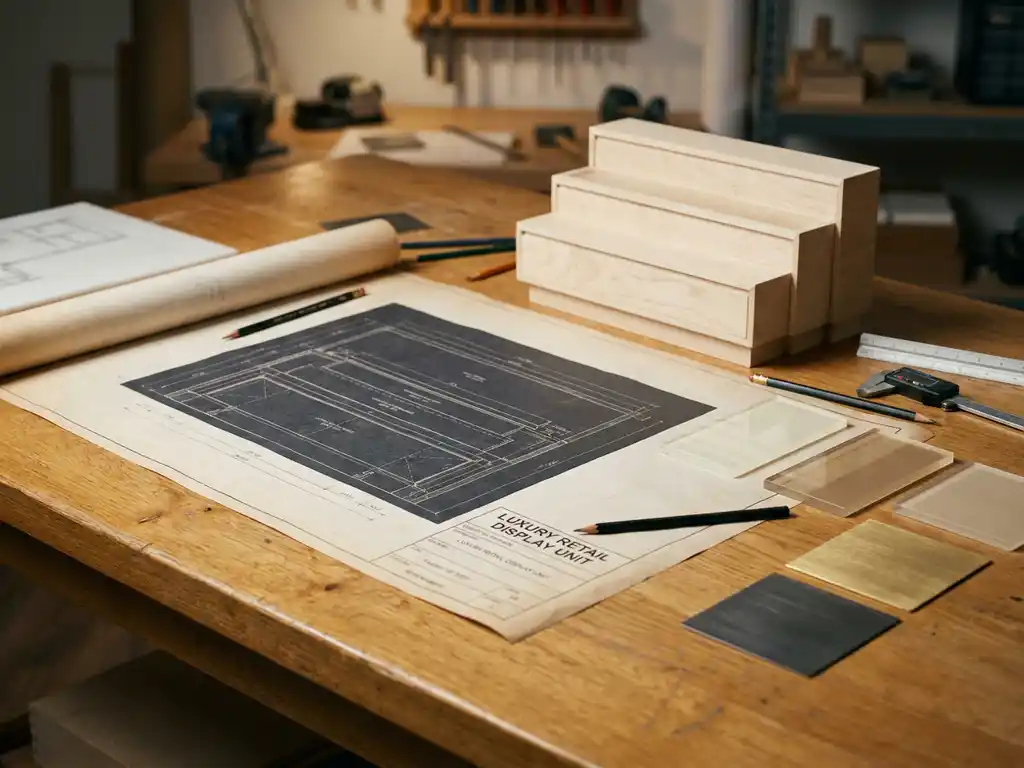
The retail display design process moves through six core stages: brief and concept development, design refinement, rapid prototyping, material selection, manufacturing, and on-site installation. Each stage builds directly on the last, ensuring the finished display is structurally sound, brand-aligned, and commercially effective. The sections below address the most common questions brands ask when commissioning a retail display for the first time or reviewing their current approach.
A retail display passes through six defined stages before it reaches the shop floor: client briefing, concept design, prototype development, material specification, manufacturing, and installation. Each stage has clear inputs and outputs, and moving through them in sequence reduces the risk of costly revisions, production delays, or compliance failures at the point of installation.
The process is linear in structure but iterative in practice. Concept work, for example, may loop back to the brief if a design direction proves technically unfeasible or exceeds budget parameters. Prototyping may trigger a revision to material choices. This controlled iteration is what separates a professionally managed retail display project from one that encounters problems only after production has begun.
For brands operating across multiple retail environments — pharmacies, department stores, supermarkets — the process must also account for retailer-specific compliance requirements, which are typically addressed during the design and prototyping phases rather than at the point of delivery.
The brief and concept phase is the most consequential stage in the retail display design process. Decisions made here — about the shopper journey, product hierarchy, brand identity, and retail environment — determine every downstream choice, from structural form to material finish. A weak brief produces a display that may look correct on screen but underperforms in store.
An effective brief defines the commercial objective of the display: is it driving trial, increasing basket size, communicating a new product launch, or reinforcing brand positioning at the point of purchase? It also specifies the retail environment, available floor or fixture space, retailer compliance rules, and any constraints on budget or timeline.
From a strong brief, the design team develops concept directions that translate brand identity into physical form. At this stage, CAD drawings and rendered visuals allow stakeholders to evaluate structural logic, shopper sightlines, and aesthetic alignment before any material or production cost is committed. The concept phase is where creative ambition and commercial reality are brought into balance.
Rapid prototyping is the production of a physical or near-finished model of a display design, created quickly and cost-effectively to test structural integrity, visual impact, and practical usability before full manufacturing begins. In retail display design, it is the stage that most reliably prevents expensive production errors and misaligned expectations.
A prototype allows the brand team, retailer, and design partner to assess the display in three dimensions — something that digital renders cannot fully replicate. Proportions that appear balanced on screen may feel oversized or visually weak when viewed at shelf height. Product placement that looks logical in a CAD drawing may create friction for the shopper in practice.
Prototyping also enables compliance testing. Many major retailers require physical sign-off on display units before granting permission to install. Having a prototype ready accelerates this approval process and reduces the risk of a finished production run failing retailer review. For brands with tight launch windows, this stage is not optional — it is a commercial safeguard.
Material choice directly affects the structural performance, visual quality, production cost, lead time, and sustainability profile of a retail display. Selecting the wrong material for a given retail environment or display type can compromise durability, increase waste, or result in a unit that fails to meet retailer standards for finish or safety.
Common materials in retail display production include acrylic, which offers clarity and a premium finish for beauty and cosmetics applications; timber and joinery, which communicate warmth and permanence for lifestyle and fashion brands; metalwork, which provides structural strength for freestanding units; and moulded components, which enable complex forms at scale. Each material carries different cost, weight, and sustainability implications.
Sustainability is an increasingly significant factor in material selection. Brands operating in health, beauty, and wellness sectors face growing pressure from both retailers and consumers to demonstrate environmental responsibility in their in-store presence. This means evaluating materials not only on aesthetic and structural grounds, but also on recyclability, responsible sourcing, and end-of-life disposal. A design partner with in-house materials expertise can guide these decisions with precision rather than approximation.
During the manufacturing phase, approved designs and prototypes are translated into production-ready units at scale. Components are fabricated, finished, quality-checked, and prepared for delivery. The installation phase then places those units in-store, aligned to retailer planograms, brand guidelines, and any site-specific requirements agreed during the briefing process.
Manufacturing quality control is critical at this stage. Each unit produced must match the approved prototype in dimension, finish, and structural performance. Variance between units — particularly on large rollouts across multiple store locations — can undermine brand consistency and create compliance issues with retailers.
Installation is where the entire process becomes visible to the shopper. Using employed fitters rather than subcontracted labour gives the design partner direct control over installation quality, timing, and problem resolution on site. Pivotal's in-store engineers completed over 2,000 retail and brand experience installations in 2025, visiting a store every 34 minutes — a scale of operation that reflects the logistical complexity involved in professional retail display installation and the importance of having a dedicated, experienced team managing it.
The retail display design process typically takes between six and sixteen weeks from initial brief to completed installation, depending on the complexity of the design, the number of units required, the materials specified, and retailer approval timelines. Simple POS display projects at the lower end of complexity can move faster; bespoke freestanding fixtures for multi-site rollouts require more time.
The stages that most commonly extend timelines are retailer compliance approval, which is outside the control of the design partner and can add weeks if submissions require revision, and material procurement, which is subject to supply chain lead times that vary by material type and volume.
Brands that engage a design partner early — ideally before a product launch date is fixed — have significantly more flexibility to manage these variables. Compressing the timeline by entering the process late forces compromises in prototyping, material selection, or installation planning that often cost more to resolve than the time saved.
Pivotal is a full-service retail design partner that manages the entire display design process in-house, from initial brief through to on-site installation. For brands seeking a single, accountable partner across the full project lifecycle, Pivotal's integrated capability removes the coordination risk that comes with using multiple suppliers across design, manufacturing, and installation.
Brands that treat the display design process as a strategic investment rather than a procurement exercise consistently achieve stronger in-store performance. If you are planning a new display project or reviewing your current in-store presence, speak to the Pivotal team to discuss your brief and timeline.