
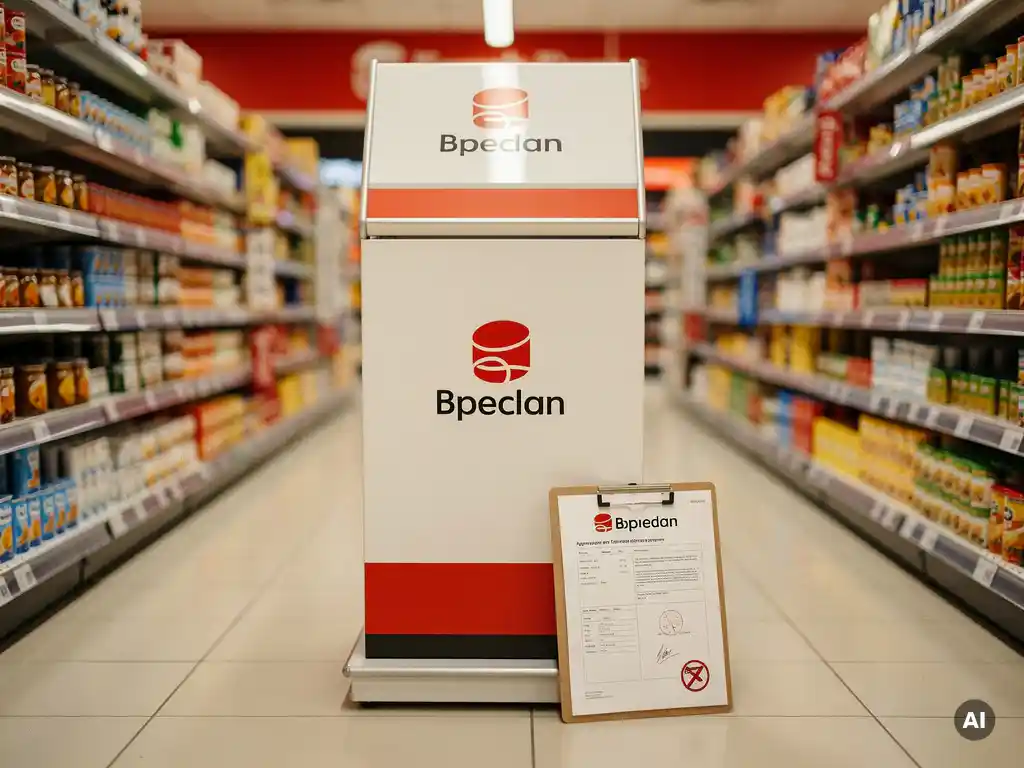
Getting a POS display approved and placed in a UK supermarket requires working through the retailer's category or commercial team, submitting display specifications for compliance review, and meeting strict guidelines on size, materials, and placement. The process is structured and can take anywhere from several weeks to several months depending on the retailer and the scale of the rollout. The sections below address the most common questions brands face when navigating supermarket display approval in the UK.
UK supermarkets assess POS displays against a set of commercial, operational, and safety criteria before granting approval. At a minimum, retailers will evaluate whether the display supports the category's commercial objectives, fits within allocated floor or fixture space, meets health and safety standards, and aligns with the store's visual merchandising guidelines. Brand alignment and shopper relevance are also considered.
Supermarkets are protective of the in-store environment. A display that disrupts customer flow, creates a trip hazard, or conflicts with adjacent brand messaging is unlikely to pass review regardless of its creative merit. Retailers also weigh the commercial case: they want evidence that the display will drive incremental sales or support a category event, not simply occupy space. Brands should approach approval with both a creative rationale and a commercial argument prepared.
Sustainability credentials are increasingly relevant in 2026. Major retailers have made public commitments to reducing single-use materials and plastic in-store, and displays that use recyclable or reusable materials are more likely to receive a favourable reception from category teams.
The first point of contact for placing a POS display in a UK supermarket is typically the retailer's category buyer or brand activation manager. These individuals manage in-store brand partnerships and control the approval pipeline for display submissions. In larger retailers, a dedicated trade marketing or shopper marketing team may handle display requests separately from the buying function.
If your brand already has a trading relationship with the supermarket, the account manager is usually the most efficient route in. They can direct the display request to the correct internal team and advise on the retailer's current priorities for category investment. For brands without an existing relationship, approaching the retailer's supplier portal or commercial partnerships team is the appropriate starting point.
It is worth noting that approval authority varies by display type. A small shelf-edge unit may sit within the buyer's discretion, while a freestanding display unit or gondola end requires sign-off from store operations and sometimes the estates team as well. Understanding this internal structure early prevents delays later in the process.
UK supermarkets enforce strict dimensional guidelines for in-store displays, typically specifying maximum footprint, height restrictions, and aisle clearance requirements. Most major retailers require a minimum aisle width to remain unobstructed, and freestanding units are generally restricted to specific zones such as gondola ends, aisle fins, or designated promotional bays. Exact dimensions vary by retailer and store format.
Placement rules are equally prescriptive. Supermarkets typically allocate display positions within planograms, and any unit placed outside the agreed footprint or in an unapproved location risks removal by store staff. Brands should request the retailer's current display specification guide early in the planning process, as these documents are updated regularly and non-compliance can result in the display being refused at the point of delivery.
Temporary displays used for promotional periods are subject to different rules than permanent fixtures. Temporary point-of-sale display approval in UK stores often involves shorter lead times but stricter restrictions on materials and construction, since the display must be assembled and dismantled by store staff rather than specialist fitters.
The supermarket POS approval process in the UK typically takes between six and sixteen weeks from initial submission to confirmed placement, though timelines vary significantly by retailer, display type, and the completeness of the submission. Brands that submit incomplete documentation or require multiple revision cycles should expect the process to take longer.
Large-scale national rollouts across multiple store locations add further complexity. Retailers need to coordinate with store operations teams to schedule installation windows, which can extend the timeline by several weeks beyond the design approval stage. Seasonal promotional periods, such as Christmas or Easter, attract high volumes of display submissions and often require brands to begin the approval process three to four months in advance of the intended launch date.
Building in adequate lead time is one of the most consistent factors that separates successful in-store display placements from those that miss their intended launch. Brands that treat the approval process as a final step rather than an integrated part of the project timeline frequently encounter avoidable delays.
Before submitting a POS display for supermarket approval, brands typically need to provide detailed technical drawings, material specifications, structural load assessments, and evidence that the unit meets relevant safety standards. For displays that will be assembled by store staff, clear assembly instructions and a component manifest are also required. Some retailers additionally request a physical prototype for review before granting final approval.
Structural integrity is a particular focus for freestanding units. Retailers may require confirmation that the display has been load-tested and will not topple under normal store conditions. Fire safety compliance is relevant for any display placed near heat sources or electrical installations. Depending on the materials used, retailers may also ask for evidence that the unit meets their own environmental or sustainability commitments.
Graphic content submitted as part of the display must typically be provided in press-ready format and may be subject to the retailer's own brand and legal review, particularly where pricing, promotional claims, or regulated product categories are involved. Having all documentation prepared in advance of submission significantly reduces the risk of delays during the approval process.
Working with an experienced retail display manufacturer materially improves the likelihood of approval because the display is designed and built to meet retailer specifications from the outset. Manufacturers with direct experience of UK supermarket guidelines understand the dimensional constraints, material requirements, and documentation standards that retailers expect, reducing the risk of non-compliance at the submission stage.
Retailer-approved manufacturers and installation teams carry additional weight in the approval process. When a supermarket's operations team recognises the installer as a known and vetted partner, the logistics of scheduling and executing the placement become more straightforward. This is particularly relevant for national rollouts, where coordinating installation across dozens or hundreds of stores requires a level of operational credibility that not all suppliers can demonstrate.
Manufacturers who offer rapid prototyping capabilities also enable brands to present a physical sample during the approval process, which can accelerate sign-off by giving buyers and category managers a tangible reference point rather than relying solely on technical drawings.
Pivotal provides end-to-end support for brands seeking to place POS displays in UK supermarkets, managing the process from initial concept through to on-site installation. Working with Pivotal means the compliance and documentation requirements are built into the project from day one, not treated as an afterthought.
If your brand is planning a supermarket display rollout and needs a manufacturing and installation partner with proven retailer relationships, contact Pivotal to discuss your project requirements.