
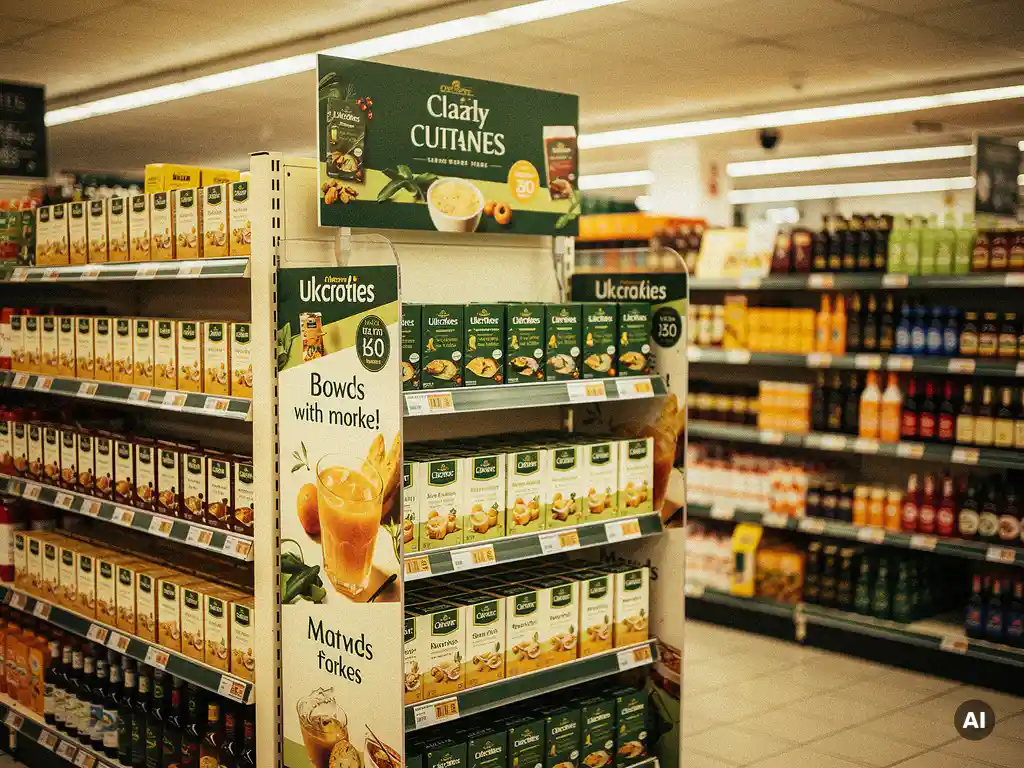
The most common POS display formats used in UK grocery retail include free-standing display units (FSDUs), shelf-edge strips and wobblers, dump bins, end-of-aisle displays, and header boards. These formats are used across major grocery multiples and independent retailers alike, each serving a distinct purpose in guiding shopper attention and driving purchase decisions at the point of sale.
The right format depends on a brand's product category, retailer guidelines, available floor space, and campaign objectives. Understanding the full range of options, and the commercial logic behind each, is essential for any brand investing in grocery retail POS.
End-of-aisle displays and free-standing display units consistently deliver the strongest sales uplift in grocery retail environments. Their positioning outside the standard shelf run gives them disproportionate visibility, capturing shoppers who may not travel the full aisle. Dump bins and promotional stacks also perform strongly for impulse-driven categories, particularly when positioned near high-traffic zones.
The effectiveness of any in-store display format is closely tied to its placement, creative execution, and how well it communicates a clear offer or product benefit. Shelf-edge strips and wobblers, while lower in physical presence, are effective at reinforcing brand messaging directly at the point of decision, particularly for established products competing within a category.
A temporary POS display is designed for short-term use, typically tied to a promotional campaign, product launch, or seasonal event, and is usually constructed from lightweight materials such as corrugated card or foamboard. A permanent POS display is built to last, using durable materials like acrylic, metal, or engineered wood, and is intended to remain in-store for an extended period, often as part of a branded fixture or dedicated product bay.
The choice between temporary and permanent formats has significant commercial implications. Temporary displays offer speed and cost efficiency, making them well-suited for limited-time offers or trial campaigns. Permanent displays represent a greater upfront investment but deliver long-term brand presence, improved shopper navigation, and stronger retailer relationships, particularly where a brand occupies a dedicated space within a store.
Many brands use both in parallel: a permanent fixture to anchor the brand within a category, supported by temporary POS to drive promotional activity around it.
POS displays are most effective at high-traffic locations within a grocery store, including store entrances, end-of-aisle positions, checkout areas, and cross-merchandising zones adjacent to complementary product categories. These locations intercept shoppers at moments of maximum attention and lowest purchase resistance.
Entrance zones and gondola ends are among the most commercially valuable positions in any grocery store. Retailers typically reserve these for promotional activity or category-leading brands, and competition for these spaces is significant. Checkout and queue-line areas are particularly effective for impulse categories, confectionery, health supplements, and personal care products frequently perform well in these zones.
Cross-category placement is an increasingly important strategy. A brand placing a display adjacent to a complementary product, for example, a sauce brand positioned near fresh pasta, can intercept shoppers at the point of a related purchase decision, increasing basket size and brand visibility simultaneously.
POS displays in UK grocery retail are governed by a combination of retailer-specific guidelines, industry codes of practice, and statutory regulations. Key areas include restrictions on the promotion of high fat, salt, and sugar (HFSS) products, rules on alcohol promotion placement, and each retailer's own approval processes for in-store display units.
The UK Government's HFSS regulations, which restrict the placement of qualifying products in prominent store locations such as entrances and end-of-aisles, have had a direct impact on how brands design and position their grocery POS. Brands operating in affected categories must ensure their display formats comply with both location restrictions and any associated promotional messaging rules.
Beyond statutory requirements, major grocery retailers including Tesco, Sainsbury's, and Asda operate detailed supplier guidelines that govern display dimensions, materials, fixings, and installation methods. Any brand seeking to place a display in a major grocery multiple must submit designs for retailer approval before production begins, a process that makes working with an experienced retail display partner a significant operational advantage.
Grocery brands select a POS display format by evaluating four core factors: the product category and its purchase behaviour, the available retail space and retailer guidelines, the campaign budget and timeline, and the intended duration of the display in-store. Aligning these factors with the right format ensures the display delivers measurable commercial return.
Impulse categories, snacks, confectionery, health drinks, typically benefit from high-visibility formats positioned away from the main shelf run. Considered purchases, such as premium health or beauty products, often perform better with well-structured, permanent branded fixtures that communicate product credentials clearly and support shopper decision-making.
Budget and lead time are also decisive. A corrugated FSDU can be designed, produced, and delivered in a matter of weeks; a permanent acrylic and metal fixture requires longer development, tooling, and retailer approval processes. Brands with a defined promotional calendar should plan display formats well in advance to avoid compromising on quality or compliance.
UK grocery POS displays are made from a range of materials depending on whether the display is temporary or permanent, the retailer's specifications, and the brand's sustainability commitments. The most commonly used materials include corrugated card, acrylic, metal, MDF, and foamboard, each offering a different balance of cost, durability, and visual impact.
Corrugated card and foamboard dominate temporary POS production due to their low cost, light weight, and ease of print finishing. These materials are suitable for short campaign windows and can be produced at scale without significant tooling investment. Sustainability-focused brands increasingly specify FSC-certified board and water-based inks to reduce environmental impact.
Permanent grocery displays typically use acrylic, powder-coated steel or aluminium, and engineered wood such as MDF or plywood. Acrylic offers a premium, high-gloss finish well-suited to beauty and health brands, while metal frameworks provide structural durability for high-volume product loads. Joinery and woodwork elements are common in premium or lifestyle brand fixtures where warmth and texture are part of the brand identity.
Material selection also has direct implications for retailer approval. Grocery multiples have specific requirements around fire ratings, fixing methods, and structural integrity, all of which must be accounted for during the design and specification stage.
Pivotal is a UK-based, full-service retail design company that supports grocery brands at every stage of the POS display process, from initial concept and material specification through to manufacturing, retailer approval, and on-site installation. With over 2,000 retail and brand experiences installed in 2025 alone, Pivotal brings the scale, expertise, and retailer relationships that grocery brands need to execute confidently in competitive retail environments.
Whether a brand is launching a new product line, refreshing an existing fixture, or navigating HFSS compliance requirements, Pivotal provides the in-store display capability to deliver results. Contact Pivotal to discuss your grocery retail POS requirements and find out how the team can support your next campaign.