
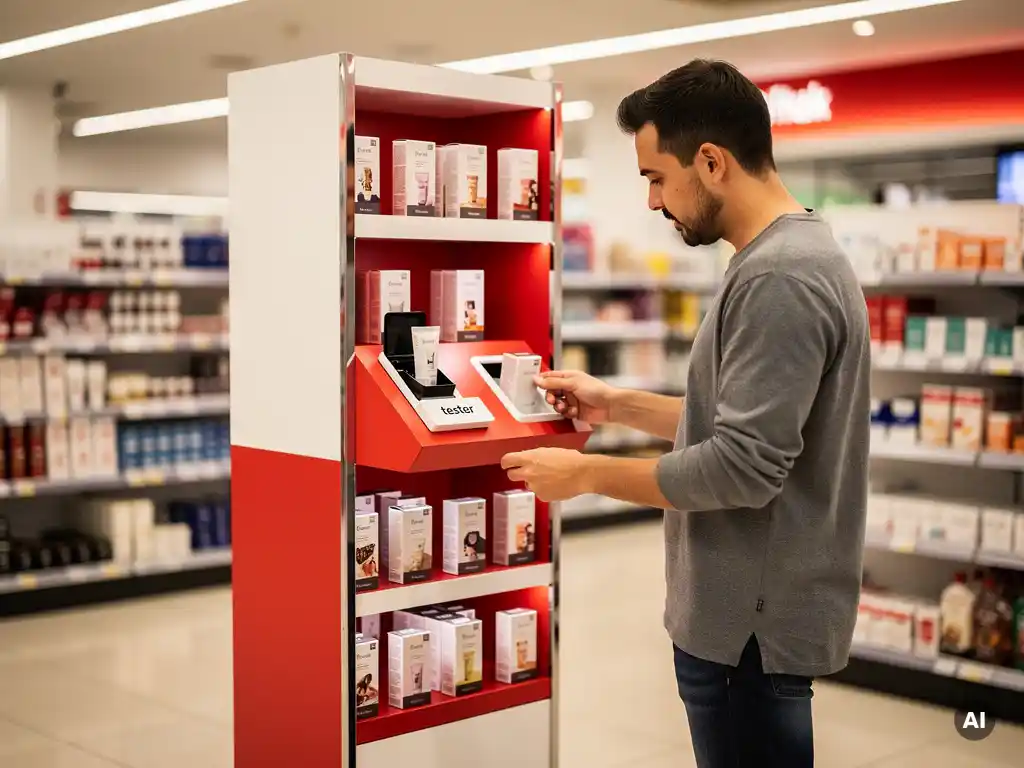
Brands use point of sale displays to drive trial of a new product in UK stores by placing compelling, informative, and physically engaging materials at the exact moment a shopper is ready to make a purchasing decision. The most effective POS strategies combine strong creative execution with precise placement, ensuring the product stands out in a crowded fixture and gives shoppers both the reason and the confidence to try something unfamiliar. The sections below address the key strategic and executional questions that determine whether a new product launch converts browsers into buyers.
The most effective POS displays for new product trial are those that interrupt the shopper's existing routine and create a reason to stop, engage, and pick up the product. Freestanding display units (FSDUs), countertop units, and dedicated shelf-edge fixtures consistently outperform standard shelf placement when a brand is launching something unfamiliar to shoppers.
Each display type serves a distinct role in the trial journey. FSDUs give a new product its own branded space, separating it from established competitors and signalling that something new and noteworthy has arrived. Countertop units work particularly well in pharmacy and health retail environments, where proximity to the till creates a moment of considered impulse. Shelf-edge units and barkers draw attention within an existing category, redirecting a shopper's gaze to the new product without disrupting their navigation of the aisle.
Sampling units and testers are among the most powerful tools in the trial toolkit, particularly in beauty, skincare, and food categories. When a shopper can interact with a product before committing to purchase, conversion rates improve significantly. Temporary promotional displays that incorporate a tester or sample mechanism turn passive awareness into active engagement.
POS placement directly influences trial by determining whether a shopper encounters a new product at a moment of openness or distraction. A display positioned at the entrance to a category aisle, at a high-traffic junction, or adjacent to a complementary product category reaches shoppers before their decision-making is already complete.
The psychology of in-store navigation is well established in shopper marketing. Shoppers move through stores with a degree of autopilot behaviour, gravitating towards familiar products in familiar locations. A new product placed within that existing pattern is easily overlooked. Effective placement disrupts that pattern by positioning the display where dwell time is naturally higher, such as near consultation points in pharmacies, at queue barriers, or at the end of gondola fixtures.
Proximity to related products also plays a meaningful role. A new skincare product placed alongside an established brand in the same range, or adjacent to a product the shopper already purchases, benefits from a halo of trust. The shopper's familiarity with the adjacent product reduces the perceived risk of trying something new, making trial more likely without requiring additional persuasion from the display itself.
A POS display drives trial rather than just awareness when it communicates three things clearly and quickly: what the product is, why it is worth trying, and what the shopper should do next. Awareness-focused displays often stop at the first point. Trial-focused displays push through all three within the two to three seconds of attention a shopper typically gives a fixture.
The design elements that differentiate a trial-driving display include:
Material choice also contributes to trial conversion. A display constructed from quality materials signals product quality by association. Brands that invest in well-finished, durable fixtures communicate confidence in their product, which transfers to the shopper's perception of the product itself.
In the UK, pharmacy chains, department stores, and specialist health and beauty retailers offer the strongest environments for new product trial, particularly for brands in skincare, wellness, and personal care categories. These environments attract shoppers who are actively seeking solutions and are more receptive to trying unfamiliar products that address a specific need.
Boots UK remains one of the most commercially significant environments for new product trial in the health and beauty sector. Its shopper base actively engages with new launches, and the retailer's category management approach creates defined opportunities for branded display activity. Department stores with dedicated beauty halls, such as John Lewis, provide similar conditions at a premium positioning level.
Supermarkets offer scale and frequency of visit, making them well suited to food, beverage, and household product launches where repeat purchase is the objective. However, the competitive intensity of supermarket environments means that display standout requires stronger creative investment to achieve the same rate of trial engagement.
Specialist retailers, including independent pharmacies and health food stores, offer a different advantage: a more consultative shopping environment where shoppers spend longer with a product and are more likely to read claims and engage with detailed display content. For brands targeting a considered purchase decision, these environments can deliver higher-quality trial even at lower footfall volumes.
Brands measure POS-driven trial through a combination of sales uplift data, redemption tracking, and shopper research conducted during and after the display period. The most direct indicator is a measurable increase in unit sales of the new product in stores carrying the POS activity compared to stores without it, a method known as matched store testing.
Additional measurement approaches include:
Compliance is frequently an underestimated variable in POS measurement. A display that reaches only a proportion of planned locations, or that is incorrectly positioned within the store, will underperform against its potential and produce misleading data. Brands that invest in rigorous installation and compliance processes are better placed to draw accurate conclusions from their trial measurement.
Pivotal is a full-service retail design and installation partner that supports brands through every stage of a new product launch in-store, from initial concept through to compliant, on-shelf execution. For brands seeking to convert new product awareness into measurable trial, Pivotal provides:
In 2025 alone, Pivotal installed over 2,000 new retail and brand experiences across the UK, and 15 new global brands selected Pivotal as their in-store partner. If your brand is preparing a new product launch and requires a retail display partner with the capability to deliver at scale and with precision, speak to the Pivotal team to discuss your brief.