
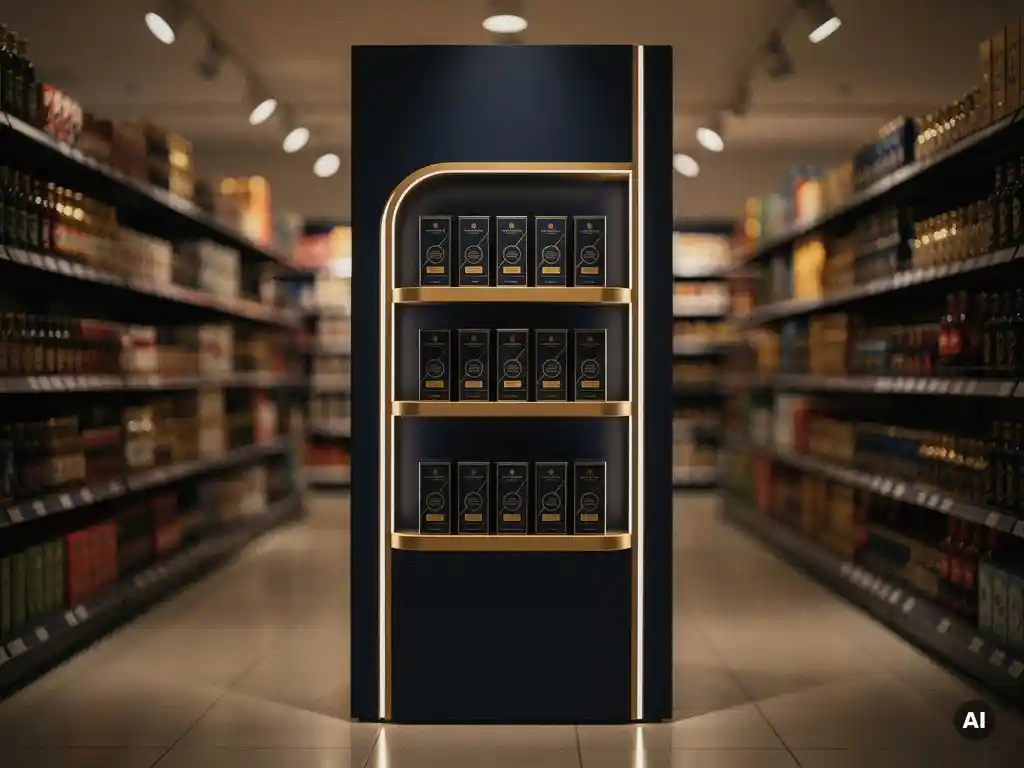
A POS display stands out in a cluttered retail aisle when it combines a clear visual hierarchy, a single compelling message, and placement that intercepts the shopper's natural sightline. The most effective point of sale displays do not compete with the surrounding noise, they cut through it by making the brand's proposition immediately legible at a distance. The questions below unpack the specific design, material, and strategic decisions that determine whether a display drives conversion or disappears into the shelf.
Shoppers stop at a display when it delivers a clear, relevant signal within the first fraction of a second. In a cluttered retail aisle, the brain filters out visual complexity rapidly. A display that leads with a single dominant element, whether colour, form, or message, gives the eye an anchor. Displays that try to communicate everything at once are processed as background noise.
Beyond visual clarity, relevance drives dwell time. A shopper who recognises the brand, understands the product category instantly, or sees a price or promotion that matches their intent will pause. This is why strong in-store display design begins with shopper insight rather than brand aesthetics alone. The question is not what the brand wants to say, it is what the shopper needs to see at that precise moment in their purchase journey.
Physical differentiation also plays a role. A display that occupies a different plane, whether it extends above the shelf line, projects into the aisle, or uses a distinctive material finish, creates a pattern interrupt. Shoppers are conditioned to scan shelves horizontally; anything that breaks that rhythm earns attention.
A high-performing POS display is built around five core design elements: visual hierarchy, message clarity, brand consistency, structural integrity, and shopper accessibility. Each element must work in concert, a display that is visually striking but difficult to interact with will not convert. Equally, a display that is functional but visually undifferentiated will not attract the shopper in the first place.
Display placement is one of the highest-impact variables in retail display design. A well-designed unit placed in the wrong location will consistently underperform a simpler unit placed correctly. The primary factors are sightline, traffic flow, and proximity to the purchase decision moment.
End-of-aisle positions, known as gondola ends, offer maximum exposure because they intercept shoppers before they commit to a specific aisle direction. Free-standing display units placed at category entry points benefit from the same logic, they meet the shopper when intent is forming rather than after it has been satisfied by a competitor's product. Eye-level placement within a fixture remains the highest-converting shelf position, and this principle extends to display design: the primary message and hero product should always sit within the natural sightline of a standing adult.
Placement must also account for retailer compliance requirements. Major retailers specify precise footprint dimensions, height restrictions, and positioning rules. Professional installation teams with retailer approval, such as those Pivotal deploys across national rollouts, ensure that displays are positioned correctly and consistently across every store location, protecting both the investment and the brand relationship with the retailer.
A temporary POS display is designed for a defined campaign period, typically four to twelve weeks, and is constructed from lighter, lower-cost materials such as corrugated card or lightweight plastics. A permanent display is built for an extended lifespan, often one to three years or more, using robust materials such as acrylic, metal, or engineered wood, and is designed to maintain its visual quality under sustained shopper interaction.
The distinction goes beyond materials. Temporary displays are optimised for speed and cost efficiency: they support product launches, seasonal promotions, or trial campaigns where agility matters more than longevity. Permanent displays represent a longer-term brand investment, designed to anchor a category space, build brand familiarity over time, and justify a higher unit cost through extended use.
The choice between the two is not always binary. Many brands use a permanent structural unit as a base fixture and rotate temporary graphic panels or promotional inserts to keep the display current without replacing the entire structure. This hybrid approach balances cost efficiency with visual freshness, a particularly effective strategy for brands managing multiple retail channels simultaneously.
Materials and finishes communicate brand values before a shopper reads a single word of copy. A display constructed from premium materials, polished acrylic, brushed metal, lacquered joinery, signals quality and investment. A display built from poorly finished or visibly degraded materials creates the opposite impression, regardless of the product it carries.
In the beauty, skincare, and wellness sectors, where brand trust is closely tied to perceived quality, material selection is a strategic decision. Brands such as La Prairie or Estée Lauder use display materials that mirror the premium positioning of their products, because the display itself is part of the brand experience. In contrast, a value-led brand may deliberately use materials that signal accessibility and practicality.
Finish choices also affect durability. High-gloss surfaces show fingerprints and wear more readily than matte or textured finishes. In high-traffic environments such as pharmacy chains or supermarkets, a display's ability to maintain its appearance over weeks of shopper interaction directly affects how the brand is perceived at the end of a campaign cycle. Material specification is therefore both an aesthetic and a commercial decision.
A brand should invest in a bespoke display when its product, positioning, or retail environment cannot be adequately served by a standard off-the-shelf unit. The clearest signals are a distinctive product format that standard fixtures do not accommodate, a premium brand positioning that a generic display would undermine, or a retailer environment with specific spatial or compliance requirements that standard units do not meet.
Bespoke retail display design is also justified when a brand is entering a new retail channel and needs to establish category presence from scratch, or when an existing display is consistently underperforming relative to the category. In these cases, a bespoke solution designed around shopper insight and specific retail context will outperform a standard unit adapted to fit.
The cost of a bespoke display should be evaluated against the cost of poor in-store performance. A standard unit that fails to attract attention or hold product correctly over a twelve-week campaign represents a significant wasted investment in production, logistics, and retail space. A bespoke unit that performs consistently across a national rollout delivers measurable return across every store location.
Pivotal is a full-service retail design partner that takes brands from initial concept through to installed, compliant, retailer-approved displays across the UK. For brands facing the challenge of cutting through a cluttered retail aisle, Pivotal provides an integrated capability that covers every stage of the process:
If your brand is planning a new retail display or reviewing the performance of existing in-store fixtures, speak to the Pivotal team to discuss how a bespoke, end-to-end approach can deliver measurable results at the point of purchase.