
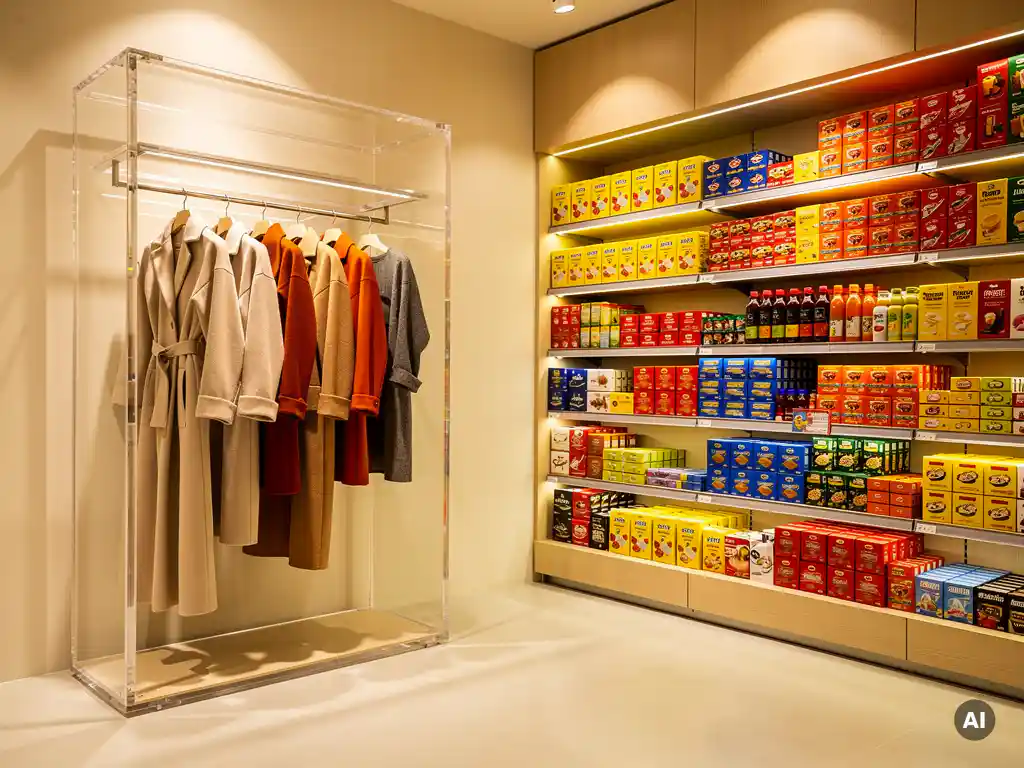
POS strategy differs fundamentally between fashion retail and FMCG brands because the two sectors operate on contrasting commercial rhythms, shopper behaviours, and retailer relationships. Fashion POS is built around identity, aspiration, and seasonal change, while FMCG POS is engineered for speed, volume, and rapid purchase decisions at the shelf. Understanding these structural differences is essential for any brand investing in physical retail display.
The questions below unpack the key strategic distinctions, from display lifespan and material selection through to retailer compliance and the temporary versus permanent display decision.
In fashion retail, POS decisions are driven primarily by brand identity, seasonal narrative, and the aspirational experience a display creates. In FMCG, the primary drivers are purchase conversion, shelf visibility, and promotional mechanics. These different commercial objectives produce fundamentally different briefs, timelines, and design priorities for in-store marketing.
Fashion brands invest in POS to communicate a world, a lifestyle, a season, a mood. A display in a department store or boutique must reinforce brand positioning as much as it sells product. The shopper is often browsing, and the display must draw them in before any product interaction occurs.
FMCG brands, by contrast, are competing for attention in an environment where shoppers move quickly and decisions are made in seconds. POS here must work harder to intercept, inform, and convert, often against a backdrop of competing brand messages on the same shelf or fixture. Price, promotion, and product differentiation are the central levers of FMCG point of sale strategy.
Fashion POS displays are typically designed to last one to two seasons, aligning with collection cycles of roughly eight to sixteen weeks. FMCG displays often have shorter promotional lifespans of four to twelve weeks for temporary units, though permanent or semi-permanent fixtures in pharmacy and grocery environments may be expected to perform for one to three years.
This difference in display lifespan has significant implications for investment levels and material specification. A fashion brand launching a seasonal window or in-store installation can justify higher production values because the display carries brand equity beyond its functional role. The aesthetic quality of the unit is part of the message.
For FMCG brands, the economics of display longevity are more tightly tied to promotional ROI. A temporary corrugated or lightweight display deployed across hundreds of grocery stores needs to be produced efficiently and at scale. Permanent FMCG fixtures, such as branded bays in pharmacy or health and beauty aisles, require more durable construction and must accommodate product range updates without full replacement.
Fashion POS displays typically benefit from premium materials such as acrylic, powder-coated metalwork, lacquered joinery, and tactile surface finishes that reinforce brand quality. FMCG displays more commonly use corrugated board for short-term promotions, alongside injection-moulded plastics, wire, and medium-density fibreboard for longer-running shelf fixtures and branded bays.
Material selection in fashion retail is closely tied to the perception of value. A display constructed from high-quality materials signals that the brand itself is premium, particularly in environments like department stores or specialist boutiques where the retail setting already commands a certain standard. Acrylic, metalwork, and considered joinery are frequently specified for this reason.
In FMCG, material decisions are more often governed by cost per unit, weight for logistics, and the practicalities of installation at scale. A health and beauty brand rolling out a branded fixture across several hundred pharmacy locations needs materials that are durable, easy to install, and capable of being maintained or restocked without specialist support. Sustainability is increasingly shaping material choices across both sectors, with brands seeking display solutions that reduce environmental impact without compromising structural integrity or visual appeal.
Shopper behaviour in fashion retail favours exploratory, dwell-heavy journeys, meaning POS placement should reward discovery, anchor key brand moments, and guide movement through the space. In FMCG, shoppers move with greater purpose and speed, so POS placement must intercept at decision points: the shelf edge, the aisle end, and the checkout zone.
Fashion shoppers typically spend more time in-store and are more receptive to brand storytelling through display. Placement near fitting rooms, at the entrance to a brand concession, or alongside a hero product creates opportunities for deeper brand engagement. The display does not need to close the sale alone, it contributes to a broader in-store experience.
FMCG shoppers are mission-driven. Research into grocery and pharmacy shopping behaviour consistently shows that the majority of purchasing decisions are made in-store, often within a few seconds of encountering a product. This means that POS placement must be precise: at eye level, at the point of category entry, or at a high-traffic interruption point. Off-shelf displays, aisle fins, and end-of-gondola units are effective precisely because they intercept shoppers before habitual category navigation takes over.
FMCG brands typically face stricter and more standardised retailer compliance requirements for POS than fashion brands. Major grocery, pharmacy, and convenience retailers operate detailed compliance frameworks that govern display dimensions, placement zones, fixings, and health and safety standards, and non-compliant units will not be accepted into store.
Retailers such as large pharmacy chains and grocery multiples have dedicated compliance teams and supplier guidelines that must be met before a display is approved for installation. These rules exist to protect the retailer's store environment, ensure consistency across hundreds of locations, and manage the logistics of large-scale rollouts. For FMCG brands, navigating this compliance landscape is a core part of the POS development process, not an afterthought.
Fashion retail compliance is generally more flexible, particularly in branded concession environments where the brand has greater control over the space. However, department store partners and multi-brand fashion retailers do set parameters around fixture heights, floor footprints, and brand zone boundaries. The key difference is that fashion compliance tends to be negotiated brand by brand, whereas FMCG compliance is typically standardised across all suppliers.
A brand should use temporary POS displays when supporting a time-limited promotion, product launch, or seasonal campaign, typically where the display will be in-store for fewer than twelve weeks. Permanent or semi-permanent displays are appropriate when the brand has an established, ongoing presence in a retail environment and requires a fixture that can accommodate range updates over time.
The decision is rarely purely about duration. Budget, rollout scale, and the nature of the retail relationship all influence the choice. A new product entering grocery retail for the first time might begin with a temporary corrugated display to test category placement before committing to a permanent fixture investment. A beauty brand with an established pharmacy bay, by contrast, may invest in a high-quality permanent unit that evolves with the range rather than being replaced each season.
For fashion brands, the temporary versus permanent question often maps directly onto the seasonal calendar. A promotional display supporting a new collection launch is inherently temporary. A core brand fixture within a department store concession, housing the brand's permanent range, warrants a more durable, considered construction that can be refreshed with updated graphics or product configurations without full replacement.
Pivotal works with brand owners and marketing teams across fashion, beauty, health, and FMCG to develop POS strategies that are commercially grounded and physically executed to the highest standard. Whether the brief calls for a temporary promotional display or a permanent branded fixture, Pivotal manages the full project lifecycle, from concept and CAD through to manufacturing and on-site installation by its own employed fitting teams.
In 2025 alone, Pivotal installed over 2,000 new retail and brand experiences, with in-store engineers visiting a store every 34 minutes. If your brand is reviewing its point of sale strategy and needs a partner capable of delivering across sectors and at scale, contact Pivotal to discuss your next in-store project.