
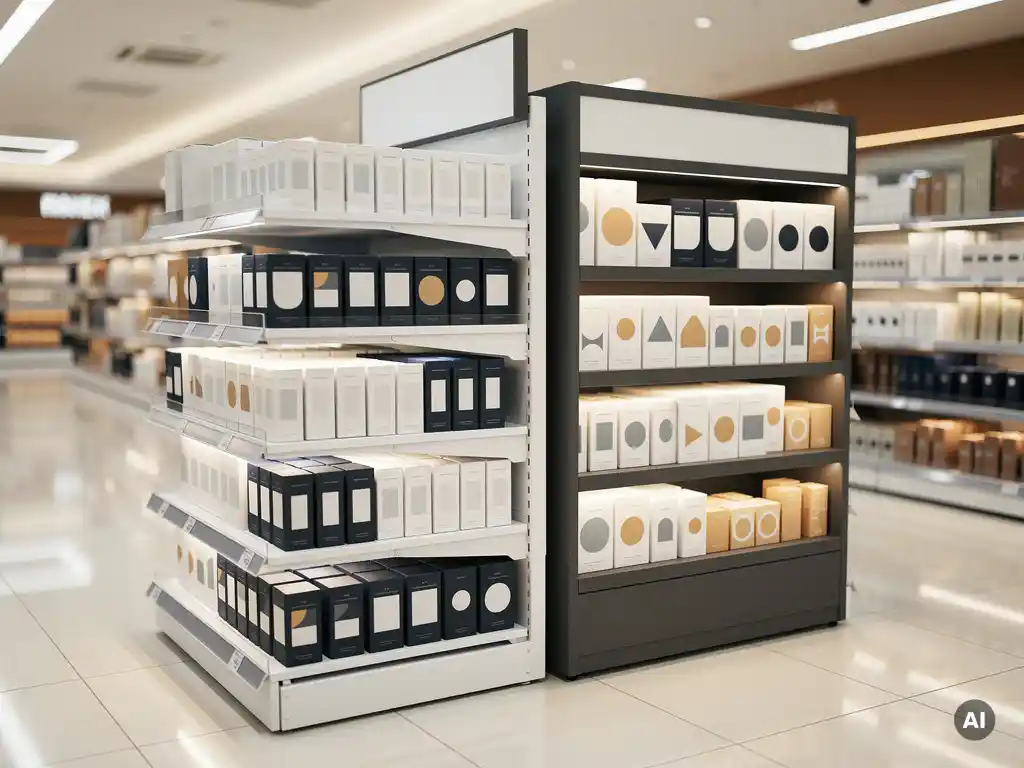
A floor stand display and a gondola end display are two distinct retail fixture formats that differ primarily in placement, structure, and commercial purpose. A floor stand is a freestanding unit positioned anywhere on the shop floor, while a gondola end display occupies the end cap of a fixed shelving unit. Understanding this distinction is essential for brands making strategic decisions about in-store display investment. The sections below address the most common questions around both formats.
A floor stand display can be positioned anywhere on the shop floor, at the entrance, within a category aisle, near a checkout, or in a high-traffic zone identified through shopper insight. A gondola end display, by contrast, is fixed to the end of a gondola shelving run and occupies a defined position within the store's fixture layout, typically at the junction of two aisles.
This positional difference has significant commercial implications. Gondola ends are prime real estate within most grocery, pharmacy, and health and beauty retail environments. They capture shoppers moving between aisles and benefit from strong dwell time. Floor stands, however, offer brands the ability to intercept shoppers at multiple touchpoints, including areas outside the brand's primary category aisle. This makes floor stand placement particularly valuable for cross-category promotions or impulse-driven product launches.
A gondola end display is a branded fixture that attaches to or replaces the end panel of a standard gondola shelving unit. It typically features a flat or curved front face, a branded header, integrated shelving or peg hooks, and a footer panel. The structure is designed to integrate seamlessly with the retailer's existing shelving infrastructure while providing a distinct branded zone.
In practice, gondola end displays range from simple branded overlays applied to existing shelving to fully bespoke, three-dimensional structures with illuminated headers, digital integration, or complex material combinations. The format is commonly used in pharmacy and grocery environments, where brands such as those in skincare or health supplements use the end cap to create a brand moment at high-visibility locations. The overall aesthetic is determined by the brand's visual identity, the retailer's fixture guidelines, and the materials selected during the design and development phase.
A floor stand display is a self-supporting, freestanding unit that requires no attachment to existing store fixtures. It typically consists of a base, a central column or body structure, and a header panel, with product held on shelves, hooks, trays, or integrated pockets. Floor stands are designed to be structurally stable without wall or shelving support.
Floor stand displays vary considerably in scale and complexity. A compact spinner unit holding a small product range sits at one end of the spectrum; a multi-tiered, illuminated display unit occupying a significant floor footprint sits at the other. The format is widely used across beauty, lifestyle, and fashion retail, and lends itself to temporary promotional campaigns as well as permanent brand installations. Materials commonly include acrylic, metalwork, joinery, and moulded components, depending on the brand's positioning and budget.
Floor stand displays generally offer greater creative flexibility than gondola end displays. Because a floor stand is entirely freestanding and not constrained by an existing shelving structure, its form, footprint, height, and material specification can be designed from the ground up to reflect the brand's identity without compromise.
Gondola end displays, while offering strong visual impact, must conform to the retailer's gondola dimensions and, in many cases, its specific fixture guidelines and approval processes. This limits how dramatically the unit can deviate from standard proportions. That said, skilled retail design teams can achieve highly differentiated gondola end solutions through the use of premium materials, three-dimensional elements, and bespoke graphic treatments. The distinction is not that gondola ends lack creative potential, but that floor stands impose fewer structural constraints from the outset.
A brand should choose a floor stand display when it needs placement flexibility, is operating outside a fixed category aisle, or requires a temporary in-store display solution that can be deployed and relocated across multiple retail environments. Floor stands are also the stronger choice when the brand has full creative control and is not subject to a retailer's gondola fixture specifications.
Specific scenarios where a floor stand is the preferred format include:
Gondola ends, by contrast, are better suited to brands with established retailer partnerships, confirmed space allocations, and a need for a permanent or semi-permanent fixture that integrates with the store's layout.
In some cases, yes. Certain display units are engineered with dual-format capability, allowing them to function as a freestanding floor stand in one environment and attach to a gondola end in another. This approach is most viable when the display's structural design accommodates both configurations without compromising stability or brand presentation.
Dual-format displays are particularly useful for brands rolling out across multiple retail channels where store formats vary. However, achieving genuine dual-format functionality requires deliberate engineering from the design stage. A unit retrofitted to serve both purposes often compromises on one configuration. Brands considering this approach should raise it at the concept stage so that structural requirements, weight distribution, and attachment mechanisms can be designed in from the outset rather than added retrospectively.
Selecting the right display format is a strategic decision that affects shopper engagement, retailer compliance, and return on investment. Pivotal works with brand owners and marketing teams to determine the most effective display solution based on retail environment, campaign objectives, and long-term brand positioning. The service covers the full project lifecycle, including:
In 2025, Pivotal installed over 2,000 new retail and brand experiences, with in-store engineers visiting a store every 34 minutes. If your brand is planning a floor stand, gondola end, or any other in-store display project, contact Pivotal to discuss how the right format can be designed, manufactured, and installed to deliver measurable results at the point of purchase.